
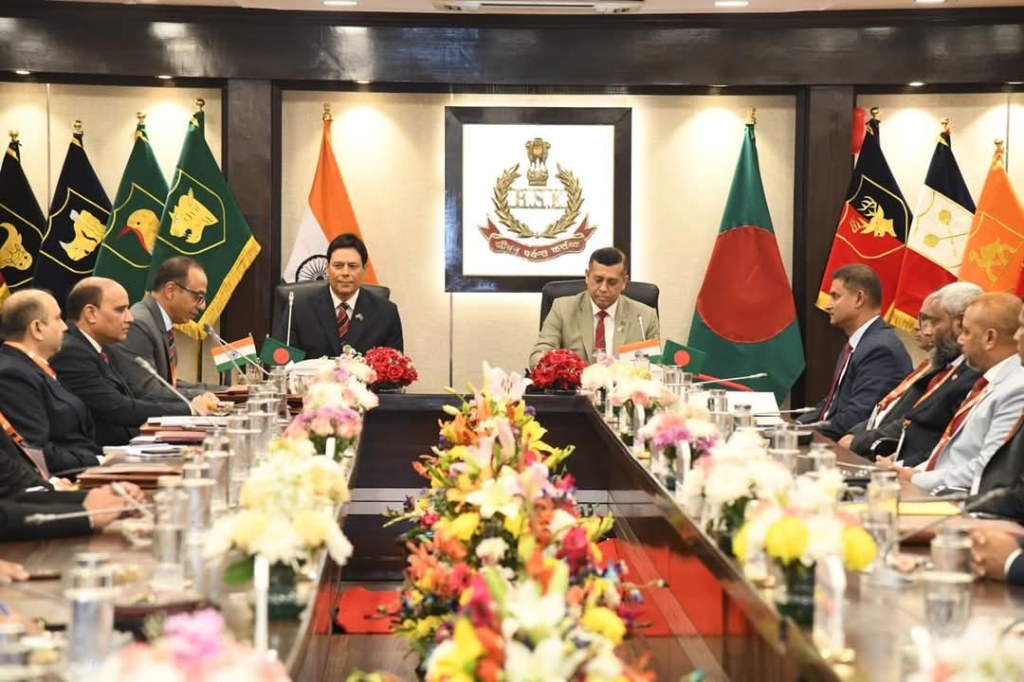
The recent meeting between the Director Generals of Bangladesh’s and India’s border guard forces has sparked significant interest in the media of both nations, underscoring its importance in the current international relations landscape.
The two border forces, Guard Bangladesh (BGB) and Border Security Force (BSF) of India, held a DG-level conference on February 17-20 in New Delhi, the Indian capital.
It is the two DGs’ first meeting since former Bangladesh Prime Minister Sheikh Hasina fled to India on August 5, 2024, following her ouster in a mass uprising resulting from widespread protests against her government’s policies.
The news headline in the state-run Bangladesh Sangbad Sangstha (BSS) was, “Bangladesh, India agrees to bring down border killings to zero.”
Both Bangladesh and India have reached a mutual agreement to implement effective measures aimed at reducing border killings of Bangladeshi nationals to zero. This significant step is a cause for hope and optimism for the future of border security.
According to a BGB press release issued on February 21, both countries agreed to exchange immediate and advanced intelligence information that would benefit both border forces, undertake public awareness programs among the people living in the border areas, undertake various socio-economic and developmental programs, and take necessary measures after a proper investigation in case of any killing on the border.
Responding to a question by The Hindu on the issue, the BGB DG said, “Attacks on minorities, I would say, were an exaggeration. Such attacks on minorities per se did not happen. The substantiation of that was the recently held Durga Puja—one of the most peacefully organized Hindu festivals.”
The statement comes days after the Indian Ministry of External Affairs told the Lok Sabha that there were reports of 23 Hindus having died and 152 incidents of attacks on Hindu temples in Bangladesh since the new regime took over, the Times of India mentioned.
Asked about the infiltration issue after former Prime Minister of Bangladesh Sheikh Hasina resigned, BSF Director General Daljit Singh Chawdhary said, “After August 5, the forces from both sides have operationally deployed to stop and curb any infiltration across the border. The infiltration has substantially decreased with the active help of the BGB.”
“Throughout the crisis and the period, the BGB stood shoulder to shoulder with us and played a crucial role in maintaining peace and tranquility on the border,” Daljit Singh Chawdhary added, emphasizing the BGB’s significant contribution to border security.
India and Bangladesh share a 4,096-km-long border spanning five States — West Bengal (2,217 km), Tripura (856 km), Meghalaya (443 km), Assam (262 km) and Mizoram (318 km).
 One-man Newsroom
Leave a comment