
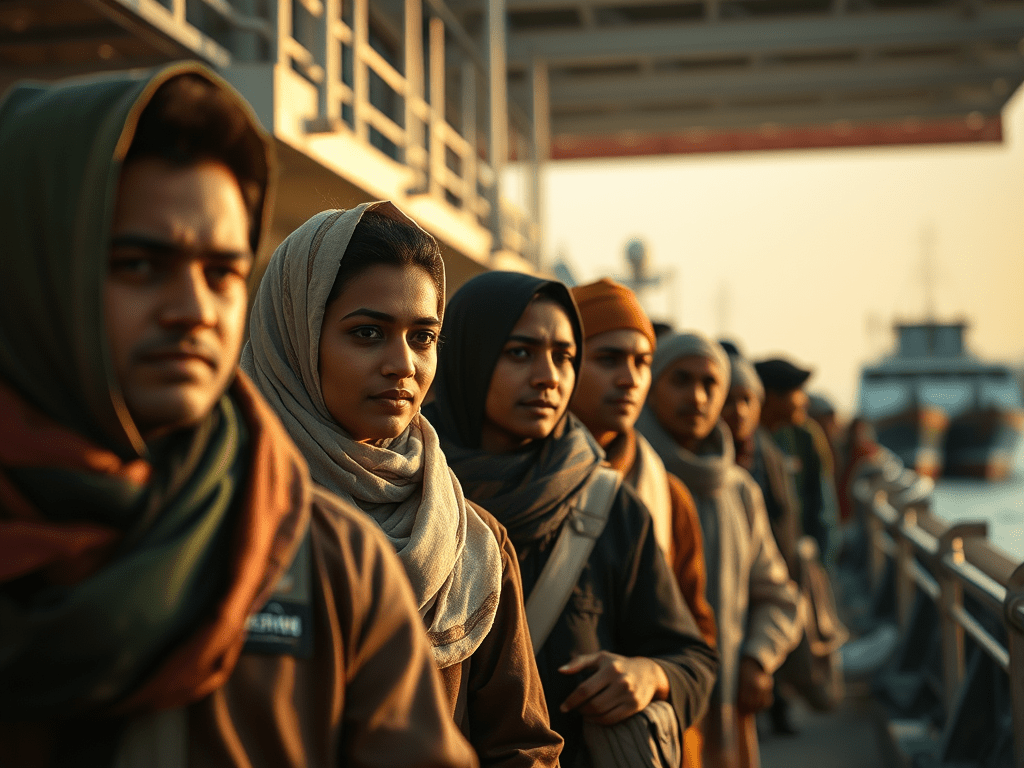
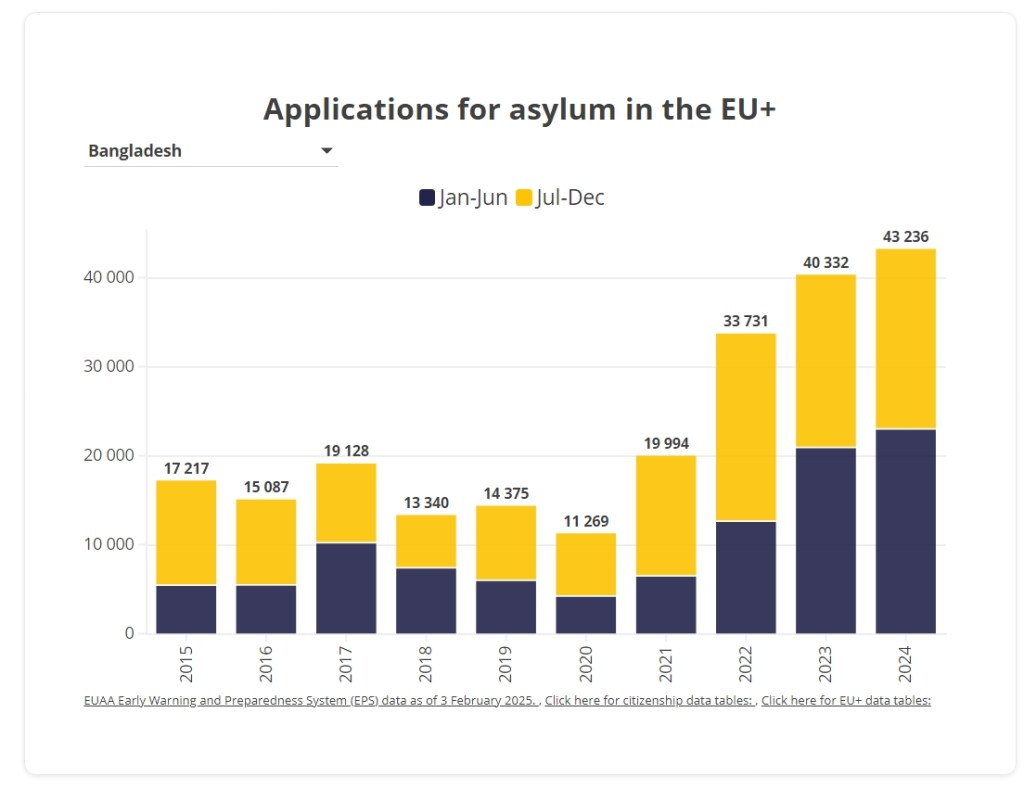
In 2024, the number of Bangladeshis seeking asylum increased by a notable 7.2%, with 43,236 applications submitted in the European Union and associated countries (EU+).
This figure represents the highest number of applications recorded in the past decade.
The urgency of this issue was emphasized in the report “Latest Asylum Trends—Annual Analysis 2024,” published by the European Union Agency for Asylum (EUAA) on March 3.
The Daily Star’s report provided a comprehensive context to the surge in asylum applications, contributing significantly to newsreaders’ understanding of the situation.
They wrote, “The report did not specify the reasons for the increase, but 2024 was a significant year, which was marked by a mass uprising and violent clashes that left around 1,400 people dead and thousands injured.”
This insight sheds light on the potential reasons behind the surge in asylum applications. The turmoil likely pushed many to seek safety abroad.
The One-Man Newsroom reviewed EUAA analysis and related publications, which highlight several key points regarding Bangladeshi asylum seekers.
Despite a high number of applications, the recognition rate for Bangladeshi asylum seekers remains very low at approximately 4%, consistent with previous years.
As of the end of 2024, 47,778 Bangladeshi applications were still pending decisions, while 1,989 applicants had withdrawn their cases.
Bangladeshis have shown strong determination and resilience despite low asylum acceptance rates. They still view Europe as a place with better jobs and living opportunities.
High unemployment and inflation in Bangladesh push people to seek better options in Europe. Many European countries consider Bangladesh a “safe country of origin.”
Well-established migration routes, especially to Italy, help Bangladeshis apply for asylum more easily.
According to the EUAA, Italy was the top destination for Bangladeshi applications, receiving 33,455 requests, representing 77% of all Bangladeshi applications in the EU+ region.
France and Ireland were next, with 6,429 and 1,006 applications, respectively.
The analysis showed that in Italy, more Bangladeshis (+43%) and Peruvians (+108%) applied for protection, while fewer Pakistanis (-28%) and Egyptians (-35%) submitted applications.
Bangladeshi nationals were the most significant applicants, making up 21% of all applications. Peruvians followed, accounting for 10%.
Several nationalities had more pending cases than a year ago, including Venezuelans (+58%), Bangladeshis (+45%), Peruvians (+55%), Guineans (+40%), and Ukrainians (+42%).

The International Rescue Committee (IRC) Italy Protection Monitoring Report (October – December 2024) highlights that Bangladeshi nationals were among the top groups of migrants arriving in Italy during this period, primarily through the Central Mediterranean route.
Many Bangladeshi migrants applied for asylum, although recognition rates remained low. As IRC Italy mentioned, Italian authorities often classify Bangladesh as a “safe country of origin.”
In 2024, Italian authorities recorded the arrival of 66,617 migrants and refugees by sea, as reported in the Yearly Regional Report (January – December 2024) by the International Organization for Migration (IOM) under its DTM Europe — Mixed Migration Flows to Europe initiative.
Since the early 2010s, migration routes have been actively utilized from the Middle East, Southeast Asia, and Africa through the Mediterranean Sea to Europe.
Following a notable surge in mixed migration flows to Europe during 2015-2016, the IOM introduced a Flow Monitoring system designed to track these flows by land and sea as part of its Displacement Tracking Matrix (DTM) tools.
The DTM Europe collects, verifies, and shares crucial information about migrants and refugees traveling to Europe via the Mediterranean, the Western African Atlantic, and the Western Balkan routes.
The report said that in 2024, 63 percent of migrants arriving by sea to Italy departed from Libya, followed by departures from Tunisia (29%), Türkiye (5%), and Algeria (2%).
The main nationalities registered at arrival in 2024 were Bangladesh (21%), the Syrian Arab Republic (19%), Tunisia (12%), Egypt (7%), and Guinea (5%).
IOM highlights that Bangladeshi nationals were among the top ten nationalities arriving in Europe through irregular migration routes, mainly via the Central Mediterranean route.
The report said that according to available data from national authorities, the Syrian Arab Republic, Mali, Afghanistan, Bangladesh, Senegal, Egypt, Algeria, and Morocco are the leading countries of origin among all registered arrivals to Europe in 2024.
In Malta, 238 migrants or refugees arrived by sea in 2024, a 37 percent decrease compared to 2023. Bangladesh (47%) was the main nationality upon arrival in Malta, followed by the Syrian Arab Republic (20%) and Pakistan (13%). Migrants reportedly departed from Libya.
IOM added that migrants and refugees from Central and South Asia (Afghanistan, Bangladesh, Islamic Republic of Iran, Pakistan) and the Middle East (Iraq, Syrian Arab Republic) tend to travel mostly by land, walking, and using several land transportation means during their journey.
Most Bangladeshi migrants departed from Libya, using it as a transit point to reach Italy and other European countries.
The Migrant Report Round 55 by IOM Libya provides insights into the situation of Bangladeshi migrants in Libya from November to December 2024.
Libya remains a key transit point for Bangladeshi migrants attempting to reach Europe. Libya’s eastern coastal and western regions saw increased migrant settlements due to better livelihood opportunities.
IOM Libya said that the majority of migrants from Asia and the Middle East were from the Syrian Arab Republic (27,046 individuals) and Bangladesh (20,275 individuals), accounting for 46% and 34% of migrants (including refugees), respectively.
Individuals from the Syrian Arab Republic and Bangladesh accounted for six percent of the overall migrant population in Libya—the sixth and seventh most represented nationalities in Libya.
An earlier EUAA publication, “Bangladesh—Country Focus, Country of Origin Information Report July 2024,” provides an in-depth analysis of key issues relevant to international protection claims from Bangladeshi nationals.
The report outlines Bangladesh’s political, social, and economic landscape, emphasizing political instability, corruption, and economic inequality.
It evaluates the functionality of Bangladesh’s justice and security systems, including their capacity to address crime and maintain law and order.
The report discusses issues such as freedom of expression, gender-based violence, and the treatment of minorities, highlighting areas where rights are often compromised.
Specific groups, such as political activists, journalists, and women fearing gender-based violence, are analyzed in terms of their vulnerabilities and risks.
 One-man Newsroom
Leave a comment