
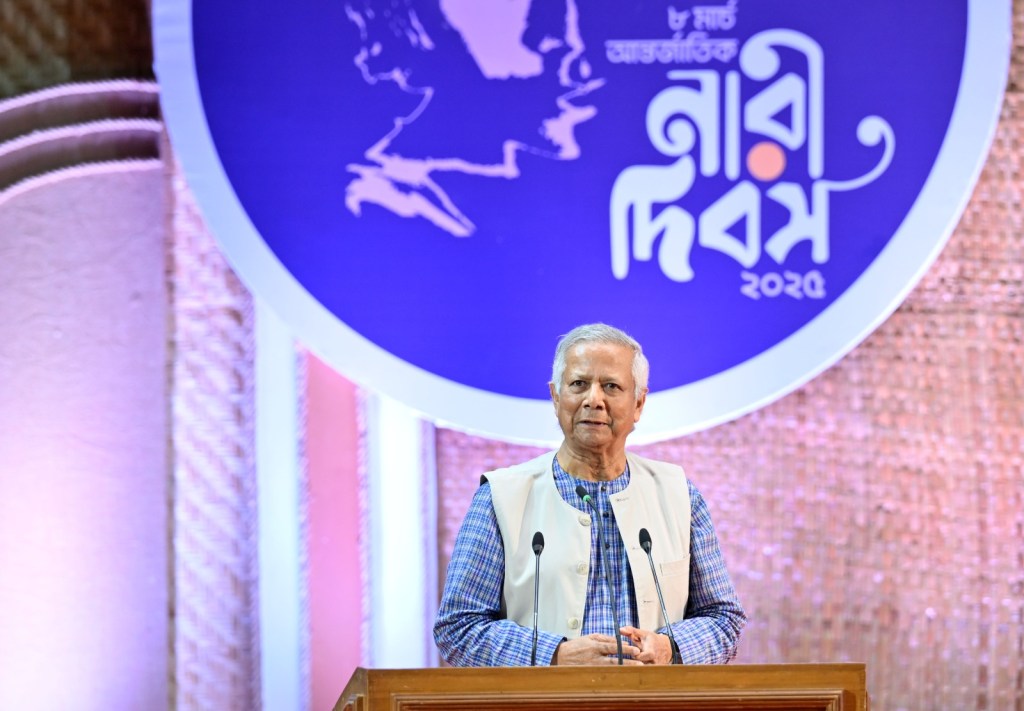
“The anti-women forces, which are trying to emerge, will have to be tackled together with all the country’s people,” said Chief Adviser Professor Muhammad Yunus at an International Women’s Day ceremony in Dhaka.
At Osmani Memorial Auditorium, Yunus emphasized the urgent need for a collective effort to combat societal attitudes undermining women. He stressed, “We must change the mindset of looking down on women in our society now, not tomorrow. Otherwise, as a nation, we will have no future.”
Photo: Chief Adviser GOB
In his speech, Yunus expressed concern over increasing violence against women, asserting that tackling these issues is essential for building a “New Bangladesh.” “We are committed to fulfilling equal rights for all men and women in this new Bangladesh. We will establish these rights by applying all our strengths,” he said.
He announced significant government initiatives, including updating domestic violence laws, drafting a new sexual harassment act, and launching a hotline for victims to report abuse. These initiatives, along with the formation of a reform commission on women’s affairs, are a testament to our unwavering commitment to women’s rights.
Yunus highlighted women’s significant contributions to various sectors, lauding their courage and resilience. He reflected on their roles in political and economic progress and their record participation in the Youth Festival 2025. The festival saw 27.4 lakh girls compete in sports and cultural activities, with widespread public support.
“The high presence of spectators proved that men also have spontaneous support for establishing women’s rights,” he added.
The adviser honored five women and the Bangladesh Female Cricket Team with the “Indomitable Women’s Award-2025” for their outstanding contributions.
Recalling the sacrifices of women in historical movements, Yunus emphasized their pivotal role in the nation’s development. He stated, “The new Bangladesh that we dream of will not be possible without the participation of women and ensuring their rights. We deeply respect and value the contributions of women in our history.”
Professor Yunus is one of the world’s most famous advocates for social change. Known as the “father of microcredit,” in 1983, he established Grameen Bank, which has since disbursed over $36.6 million in microloans, primarily to women. He provided small loans to poor people without requiring collateral. His groundbreaking work in fighting poverty and empowering women earned him the Nobel Peace Prize in 2006.
In 2024, Yunus became the Chief Adviser of Bangladesh’s interim government. Since taking office, he has focused on empowering women, tackling poverty, and promoting unity in the country. His leadership comes at a time when organizations like UN Women, Human Rights Watch, and Amnesty International have raised concerns about the state of women’s freedom in Bangladesh.
Yunus’s remarks coincide with a new global report released by UNICEF, UN Women, and Plan International, marking 30 years since the Beijing Declaration. The report highlights progress in girls’ rights worldwide but underscores persistent challenges in Bangladesh.
Despite improvements in education and health, the country has the highest child marriage rate in Asia, with over 51% of girls married before 18. Early childbirth remains common, with 24% of women aged 20–24 giving birth before 18. Additionally, 28% of adolescent girls aged 15–19 have experienced partner violence within the past year.
Bangladesh also faces substantial digital and educational gaps for adolescent girls. While secondary school completion rates are 59.22%, only 2% or fewer adolescent girls possess digital skills, one of the lowest rates globally. According to the report, these barriers hold back girls’ full potential.
UNICEF Representative Rana Flowers noted, “Adolescent girls in Bangladesh want to contribute to a flourishing Bangladesh. Yet, barriers and discrimination continue to hold them, and their country, back.”
She called for investments in life skills, digital literacy, and adolescent health services to break down these barriers. UN Women Representative Gitanjali Singh echoed these sentiments, emphasizing an “all-hands-on-deck” approach to empower girls and address harmful practices like child marriage.
Despite these challenges, the report highlights achievements such as increased life expectancy for adolescent girls, successful campaigns like the HPV vaccination drive, and growing female participation in economic activities. Kabita Bose, Country Director at Plan International Bangladesh, praised efforts to reduce adolescent birth rates but urged further action to improve the quality of education and ensure safe mobility for girls in public spaces.
Yunus concluded his speech by urging men to collaborate with women in the fight for equality. “No matter how many obstacles we face, we will fully utilize the opportunity that history has given us. We will build a new Bangladesh. This is our pledge,” he said.
While Yunus’s speech inspired many, achieving his vision won’t be easy. Violence against women remains a serious issue. Cultural norms still restrict women in some areas, and implementing new reforms takes time and effort.
 One-man Newsroom
Leave a comment