
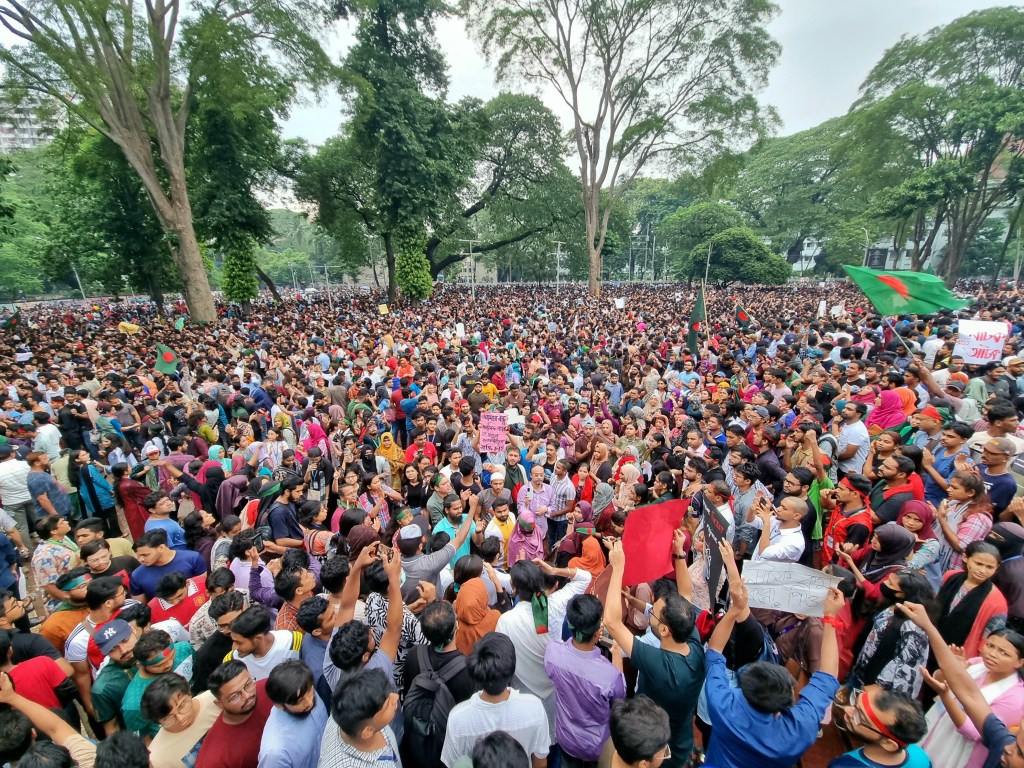
In the heart of Dhaka, where history has been written on the streets with chants and clashes, a new political force is emerging. Just months after leading the mass uprising that toppled Sheikh Hasina’s government, young revolutionaries boldly transformed their movement into a political party—the Jatiya Nagorik Party (NCP), or National Citizens’ Party.
With fire in their hearts and a vision for a “second republic,” these young leaders are challenging Bangladesh’s deeply entrenched political duopoly. International media outlets, including DW and The Diplomat, have spotlighted the NCP as a potential game-changer.
Can a party born out of student protests become a legitimate force for governance? Or will it succumb to the same political gridlock that has defined Bangladeshi politics for decades? The road ahead is fraught with both promise and peril, but one thing is sure: the NCP has already reshaped the conversation.
Key Points from Nahid Islam’s Statements
Islam’s public addresses and interviews provide crucial insight into his party’s objectives and obstacles. Below are some of the main points he addressed:
- Law and Order Concerns: Islam expressed skepticism about holding elections in the current climate, stating that the policing system has not been reformed to a satisfactory level. He emphasized that public safety remains a significant issue seven months after Hasina’s ouster (Reuters, 2025).
- The July Revolution Proclamation: Islam highlighted the need for a consensus on the “Proclamation of the July Revolution,” a proposed charter that seeks to encapsulate the demands of last year’s mass uprising. According to Islam, elections should not occur until this document is finalized (Reuters, 2025).
- Beyond Traditional Political Divisions: Islam declared at a rally on Manik Mia Avenue, “We believe the July 2024 uprising initiated the fight towards a second republic. By writing a new democratic constitution, we must eliminate any possibility of future constitutional autocracy” (DW, 2025).
- A Long-Term Political Project: Islam positioned the NCP as more than a short-term electoral contender, stating that the movement aims to shape Bangladesh’s future political landscape for the next 50 to 100 years (AFP, 2025).
- Citizen-Centric Politics: The NCP is committed to moving beyond the binary politics of secularism versus Islamism. Sarwar Tusher, a key member, explained, “Our focus is citizen-centric politics, where citizen rights are paramount, regardless of ideology” (The Diplomat, 2025).
The NCP’s Core Objectives
1. Rewriting the Constitution
One of the party’s most ambitious goals is constitutional reform. Islam and other NCP leaders argue that the current constitution, drafted in 1971 and amended multiple times since is not fit for purpose. The party believes systemic changes are needed to prevent future autocratic rule and ensure a fair political system (Guardian, 2025).
2. Breaking the Political Duopoly
Since Bangladesh’s independence in 1971, its politics have been dominated by the Awami League and the BNP. The NCP’s goal is to provide a viable third alternative. “The emergence of a third or fourth force could provide much-needed relief for the electorate,” said political analyst Masud Kamal. However, he cautioned that the NCP’s electoral success remains uncertain (DW, 2025).
3. Ensuring a Fair Electoral Process
While the interim government, led by Muhammad Yunus, has announced plans for elections by December 2025 or early 2026, Islam has voiced concerns about security and law enforcement. He suggested that elections should be postponed unless fundamental issues are resolved (Reuters, 2025).
4. Independent Foreign Policy
The NCP intends to pursue an independent foreign policy prioritizing Bangladesh’s interests above regional political allegiances. Islam stated, “We will not align with either India or Pakistan,” emphasizing the need to safeguard national sovereignty (Al Jazeera, 2025).
5. Women’s Political Representation
The NCP recognizes the critical issue of women’s underrepresentation in politics, with less than 10 percent of its 147-member central committee being women. Spokesperson Samantha Sharmin stated, “We are striving to achieve 25 percent women’s participation, but the political culture in Bangladesh remains largely hostile to women” (The Diplomat, 2025).
6. Banning the Awami League?
One of the NCP’s most contentious proposals has been its call for the interim government to ban the Awami League (AL). Samantha Sharmin criticized the BNP for opposing this move, saying, “Keeping the otherwise irrelevant Awami League’s hopes alive is a betrayal of the 2024 uprising” (DW, 2025). However, analysts warn that banning the AL could backfire, potentially shifting its voter base to the BNP (DW, 2025).
Political Implications
1. Impact on the BNP and Awami League
As the strongest opposition party, the BNP is expected to be the NCP’s most formidable electoral opponent. Tensions between the two parties have already surfaced, with Sharmin accusing the BNP of obstructing efforts for national unity. BNP leader Harunur Rashid responded, “The NCP needs to wait a long time to gain the momentum to compete with us” (DW, 2025).
2. Internal Party Struggles and Ideological Clarity
Analysts argue that the NCP lacks ideological clarity despite its strong student base. Political analyst Kamal stated, “I don’t understand the new party’s policy or its ideology. They talk about participatory politics, but the mass uprising included workers, farmers, rickshaw pullers, and housewives” (DW, 2025).
3. Electoral Viability and Grassroots Expansion
While the NCP enjoys strong support among urban youth and university students, its popularity in rural areas remains uncertain. “Calculating a voter base based on social media popularity is foolish,” warned Kamal. Without a strong grassroots presence, the NCP may struggle to gain traction outside significant cities (DW, 2025).
4. Avoiding the “King’s Party” Label
The NCP has faced accusations of being a “king’s party” aligned with the interim government. Addressing these claims, Sarwar Tusher stated, “No one is forming a party on behalf of the government. This initiative is entirely independent” (The Diplomat, 2025).
The National Citizens’ Party has quickly become a significant force in Bangladesh’s evolving political landscape. While its rise has generated optimism among young voters and reformists, considerable challenges remain.
From securing legitimacy in a polarized environment to navigating internal tensions, the NCP’s path forward will determine whether it becomes a transformative force or another fleeting political experiment.
With elections looming and political uncertainty high, the coming months will be pivotal for Nahid Islam and his party. As Bangladesh stands at a crossroads, domestic and international observers will closely watch the NCP’s next moves.
References
- Reuters (2025). “Bangladesh’s interim government struggles with law and order as elections loom.”
- AFP (2025). “Student leaders form a new party to reshape Bangladesh’s political future.”
- The Guardian (2025). “Building a ‘second republic’: Students who led Bangladesh revolution launch political party.”
- Al Jazeera (2025). “Bangladesh students who deposed PM Hasina form party to fight elections.”
- The Diplomat (2025). “From Revolution to Reform: The Rise of a Youth-Led Political Party in Bangladesh.”
- DW (2025). “Bangladesh students launch a new party to shake up politics.”
 One-man Newsroom
Leave a comment