
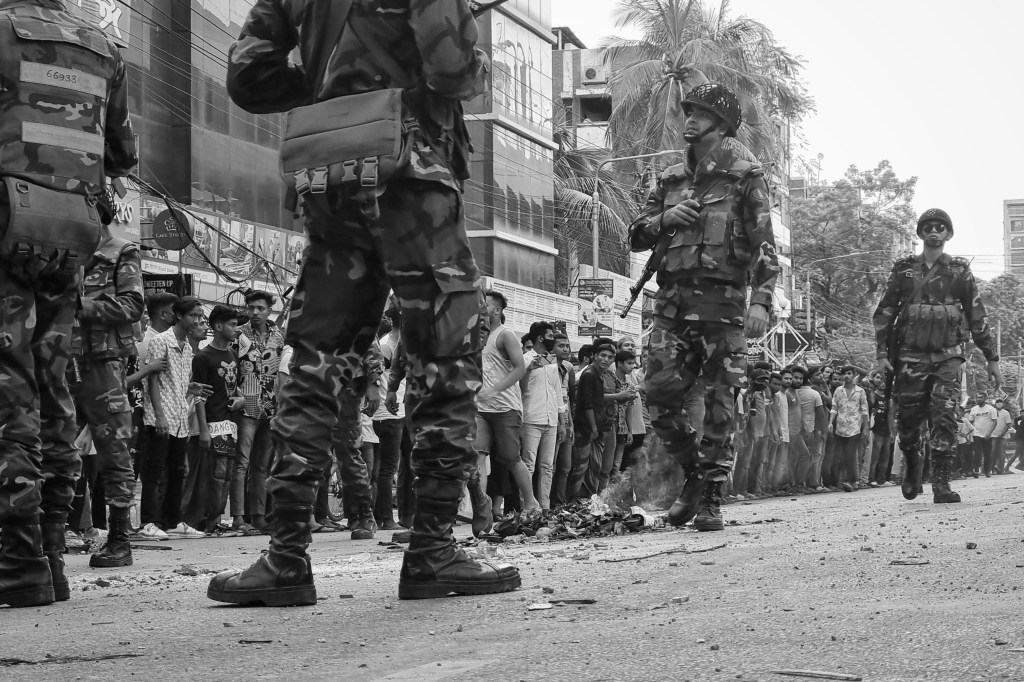
The Bangladesh Army has issued a robust statement in response to remarks made by the United Nations High Commissioner for Human Rights, Volker Türk, regarding alleged human rights violations during last year’s student-led mass protests.
The Army has underscored its unwavering commitment to the rule of law, neutrality, and human rights principles, thereby reassuring the public about the country’s stability. It has also dismissed claims that directly implicated its leadership in the events.
In a statement released Monday, the Bangladesh Army clarified that it had received no direct communication from the UN Human Rights Commissioner regarding concerns raised during his interview on BBC HARDtalk.
The Army noted that if such issues were addressed, they were directed to the former government of Bangladesh rather than the military leadership.
“The Bangladesh Army operates within the framework of national security directives and adheres strictly to the rule of law and human rights principles,” the statement said.
It further pointed out that specific interpretations of Mr. Türk’s remarks misrepresented the military’s role, which the Army claimed undermined its reputation, professionalism, and legacy of sacrifice.
Reflecting on its role in pivotal moments of the country’s history, the Army highlighted its commitment to neutrality during the 1991 democratic transition and the July-August 2024 protests, during which it worked to ensure public safety without bias or external influence.
As the second-largest contributor to UN peacekeeping missions, the Army underscored its global reputation for professionalism. It noted that its contributions generated over BDT 27,000 crore (USD 2.21 billion) to the national economy in the past 23 years.
The statement concluded by reaffirming the Army’s dedication to serving the people of Bangladesh and maintaining constructive partnerships with international bodies like the United Nations. “Any concerns regarding its role can be best addressed through open dialogue and constructive engagement,” it said.
UN Human Rights Chief Calls for Accountability
Meanwhile, in Geneva, UN High Commissioner Volker Türk presented a fact-finding report on the human rights violations during the July-August 2024 protests. Türk underscored the importance of accountability as Bangladesh navigates its political transition.
“This is a pivotal moment for Bangladesh to address its past and move toward a future of healing and truth-telling,” Türk said, calling for unity under the principle of “one country and one citizenship.”
He engaged with member states, civil society representatives, and the Bangladeshi interim government, praising their cooperation in enabling the swift deployment of the UN’s investigative team.
In a telephone conversation with Türk, Chief Adviser Muhammad Yunus emphasized that human rights remain central to the interim government’s reforms. Law Adviser Asif Nazrul, speaking at the event, acknowledged isolated incidents of retaliatory violence against individuals associated with the previous regime, condemning such acts and calling for due process.
Türk lauded the interim government’s efforts but stressed the importance of addressing revenge violence, particularly against minority groups. He described the fact-finding report as an “important contribution” to Bangladesh’s journey toward justice and accountability.
As Bangladesh charts a new future, international observers are watching closely to see how the nation balances its commitment to human rights, justice, and democratic reforms.
 One-man Newsroom
Leave a comment