
Newsman, Bangladesh—US Director of National Intelligence Tulsi Gabbard has raised profound concerns about the situation in Bangladesh, particularly regarding the persecution of religious minorities by extremist groups.
She has specifically highlighted the urgent plight of Hindus, Buddhists, and Christians who are facing immediate violence, underscoring the gravity and pressing need to address the issue.
“The longtime unfortunate persecution, killing, and abuse of religious minorities like Hindus, Buddhists, Christians, and others has been a major area of concern for the US government and President Trump and his administration,” Gabbard stated.
In an interview with NDTV, she emphasized that extremist groups aim to establish an “Islamic Caliphate,” adversely affecting individuals of other faiths through violent means.
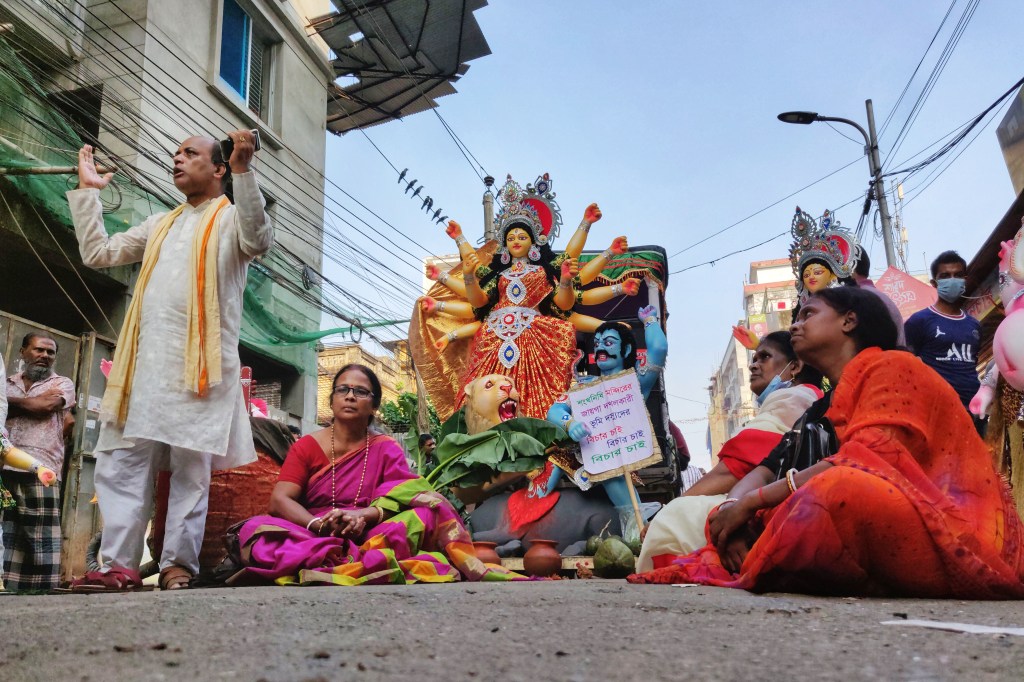
The featured photo is a 2021 photograph of a Hindu demonstration taking place on a roadway in Dhaka.
Gabbard has also revealed that the US has initiated discussions with Bangladesh’s interim government to address these pressing issues, demonstrating a strong commitment to finding a resolution.
“The talks are just beginning between President Trump’s new cabinet coming in and the Government of Bangladesh, but this continues to remain a central focus area of concern,” she said.
Bangladesh’s Response
The Office of the Chief Adviser of Bangladesh’s interim government, led by Nobel laureate Muhammad Yunus, responded to Gabbard’s remarks with concern.
“Gabbard’s comments are not based on any evidence or specific allegations. They paint an entire nation with a broad and unjustified brush,” they said.
Dhaka rejected any association with the concept of an “Islamist Caliphate,” emphasizing the nation’s peaceful and inclusive practice of Islam, a testament to its commitment to religious harmony.
“This statement is both misleading and damaging to the image and reputation of Bangladesh, a nation whose traditional practice of Islam has been famously inclusive and peaceful and that has made remarkable strides in its fight against extremism and terrorism,” it added.
Bangladesh, like many countries around the world, has faced the challenges of extremism, The office of the CA mentioned.
It underscored Bangladesh’s ongoing efforts to combat extremism in collaboration with the international community, including the US.
How Corporate Capital is Shaping a Regional Crisis
Adani, Cricket, and the India–Bangladesh Power Play.

Bangladesh has been under an interim government led by Nobel laureate Muhammad Yunus since August 2024.
The US has been particularly attentive to reports of religious intolerance, urging the Bangladeshi government to uphold fundamental freedoms and protect minority communities.
Bangladesh has previously denied allegations of religious intolerance, emphasizing its record of peaceful coexistence.
The latest remarks from the US intelligence chief indicate growing international scrutiny of Bangladesh’s internal affairs.
Historically, Bangladesh has prided itself on its secular principles and cultural diversity. However, recent incidents have raised concerns about the safety and rights of religious minorities.
The Bangladeshi government maintains that it is actively addressing these challenges, emphasizing its commitment to preserving the nation’s tradition of religious harmony.

India’s Position
India, which shares a long border and historical ties with Bangladesh, has been crucial in vigilantly monitoring the evolving situation, underscoring the significance of their involvement.
Indian Prime Minister Narendra Modi praised US President Donald Trump’s preparedness and a clear roadmap for his second term, indicating a strong bilateral relationship.
This alliance could influence regional strategies, especially in Bangladesh.
When PM Modi and Donald Trump met in Washington in February, the US President said he would let Prime Minister Modi handle the situation in Bangladesh.
“This is something the Prime Minister has been working on for a long time. Frankly, I have been reading about it. I will leave Bangladesh to the Prime Minister,” President Trump said at a joint press briefing.

Additionally, Indian Foreign Minister S. Jaishankar emphasized India’s pragmatic foreign policy approach, reflecting confidence in India’s growing economic influence and advocating for reforms in global governance structures.
Indian Army Chief General Upendra Dwivedi has expressed his concerns about the presence of ISI officials in Bangladesh areas close to India’s border regions, especially the Siliguri corridor, which underscores the broader regional implications of the situation.
Speaking to the news agency ANI, General Dwivedi said, “I had used the word epicenter of terrorism for a particular country (Pakistan). Now those countrymen, if they go to any other place and they happen to be our neighbor, as far as I am concerned, I should be concerned about it.”
“That they should not be able to use that soil to send terrorists to India,” General Dwivedi added.
Regional Implications
Bangladesh’s previous close ties with China further complicate the geopolitical landscape. The potential reduction of US aid to Bangladesh might push the nation to strengthen its relationship with China, shifting the strategic balance in South Asia and influencing regional strategies, especially concerning Bangladesh.
The United States has expressed a vested interest in maintaining regional stability, urging India and Bangladesh to resolve their differences peacefully to ensure a free and open Indo-Pacific.
Key issues now influence India, Bangladesh, and the United States. These include the treatment of religious minorities, efforts to fight terrorism, and changing political alliances.
The actions and policies these nations adopt in the coming months, particularly in response to the US’s concerns, will be crucial in determining the region’s stability and development.
The actions and policies these nations adopt in the coming months will be crucial in determining the region’s stability and development.
Dhaka and Beijing Advocate the AA’s Role in Rakhine Peace
The rebels became crucial for the Rohingya’s repatriation.

Dr. Yunus’ Diplomatic Push: Key Meetings with Xi and Modi
Bangladesh strengthens ties with China and India for stability.
 One-man Newsroom
Leave a comment