
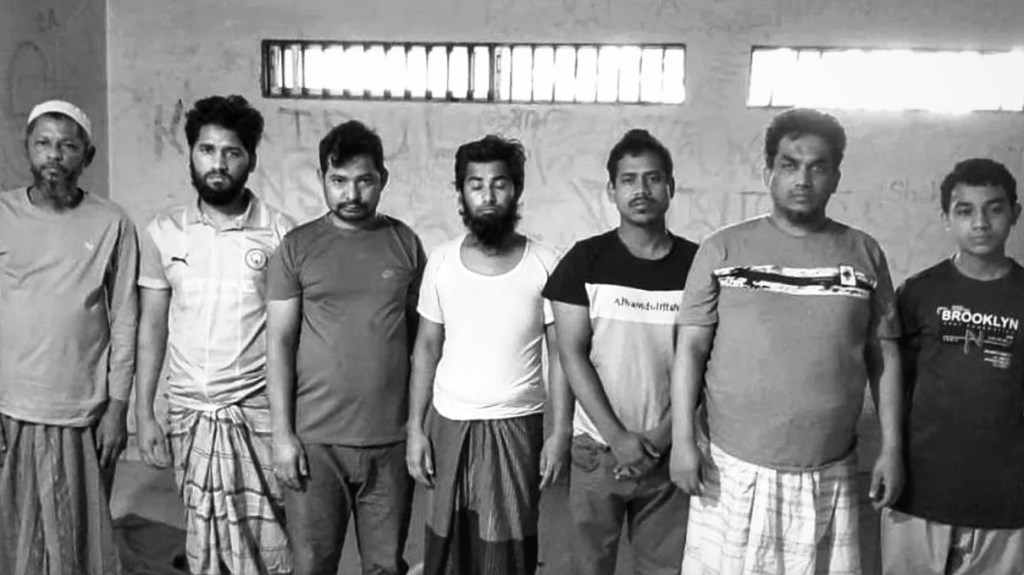
Collected Photo
Newsman, Bangladesh—For years, Ataullah Abu Ammar Jununi has been the shadowy figure at the helm of the Arakan Rohingya Salvation Army (ARSA), orchestrating attacks, evading capture, and navigating the murky underworld of cross-border militancy.
His name is synonymous with both Rohingya resistance and violent insurgency, accused of triggering one of the most significant humanitarian crises in recent history. But on March 17, 2025, his luck ran out.
In a decisive operation, Bangladesh’s elite Rapid Action Battalion (RAB-11) arrested Jununi in Narayanganj’s Siddhirganj area, along with five others suspected of militant activities. Authorities also seized over BDT 2.1 million (approximately $20,000) in cash.
This high-profile capture marks a turning point in regional security dynamics, as Jununi has a long link to violence in both Myanmar and Bangladesh.
Alongside Jununi, 48, security forces apprehended Mostaq Ahmed, 66, Moniruzzaman, 24, Salimullah, 27, Asmaul Hosna, 23, Md Hasan, 15, Md Asmat Ullah, 24, Md Hasan, 43, Shahina, 22 and Senowara, 17.
Most of the detainees are Rohingya from Myanmar’s Rakhine State, reinforcing ARSA’s deep roots in the refugee camps of Bangladesh.
Who Is Ataullah Abu Ammar Jununi?
Born in Karachi, Pakistan, to Rohingya migrant parents, Jununi later moved to Mecca, Saudi Arabia, where he received religious education before assuming leadership of ARSA.
His rise to prominence came in 2017 when his group launched coordinated attacks on Myanmar’s security forces, provoking a military crackdown that displaced over 700,000 Rohingya refugees into Bangladesh.
Jununi was involved in many notorious crimes, including the assassination of Rohingya leader Muhib Ullah in 2021 and the killing of a Bangladeshi intelligence officer in 2022. His arrest warrant had been issued as early as December 4, 2023, for his role in the latter case.
What This Means for the Rohingya Crisis
Jununi’s capture could signal a weakening of ARSA’s grip over the Rohingya refugee camps in Cox’s Bazar, potentially leading to a reduction in extortion, narcotics trafficking, and targeted killings.
For many Rohingya refugees, this could mean a momentary sigh of relief. However, his arrest also raises concerns about a possible leadership vacuum that could either dismantle the group or lead to further instability as new factions vie for control.
The arrest of Jununi, a figure synonymous with their suffering, may bring a sense of security and hope. But, for Bangladesh’s security forces, it’s just the beginning of heightened vigilance against ARSA’s remnants.
Bangladesh’s Security Forces: A Moment of Validation?
Bangladesh’s counterterrorism efforts have won a significant victory with RAB-11’s operation, although questions remain about how the global community will view the force’s actions.
In 2021, the United States sanctioned RAB over alleged human rights abuses. While this arrest might boost the unit’s standing domestically, concerns persist over whether the crackdown on ARSA will lead to further human rights challenges.
This caution is necessary to ensure that the fight against ARSA does not compromise human rights.
What’s Next?
The legal proceedings against Jununi and his associates will be closely watched. The key question remains: Is this the end of ARSA’s influence, or will the group re-emerge under new leadership, potentially with a different approach or set of activities?
For now, Bangladeshi authorities are staying on high alert, signaling their intent to dismantle militant networks operating within refugee camps and beyond.

 One-man Newsroom
Leave a comment