
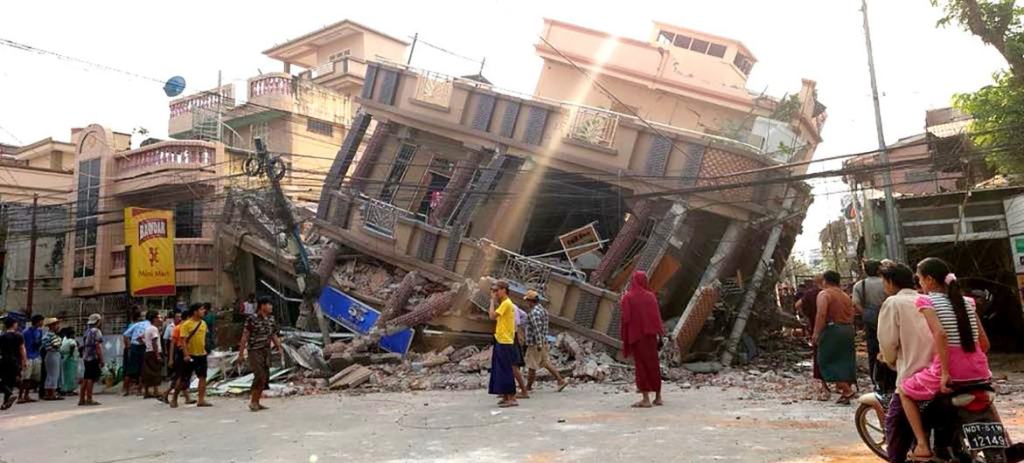
The 7.7 magnitude earthquake caused significant damage to buildings in the Mandalay region in central Myanmar. 📷 UNICEF
Newsman, Bangladesh
A powerful 7.7-magnitude earthquake struck central Myanmar on March 28 at approximately 12:50 PM local time (06:20 UTC), causing widespread destruction near Mandalay. As of March 29, the death toll has risen dramatically.
Myanmar’s military rulers report at least 1,644 fatalities, with 3,408 injured and 139 missing. UN News, “Myanmar Earthquake: Relief efforts mobilized as death toll climbs,” indicates that the death toll is climbing.
The earthquake collapsed buildings, bridges, and other infrastructure, particularly in Mandalay. The international community mobilized quickly.
According to The Week and New York Post, The international community has responded promptly. The United Nations allocated $5 million to initiate relief efforts.
China, Hong Kong, and Russia have dispatched teams and supplies to assist in the rescue operations. BBC’s live updates have tracked developments around the clock.
The European Union has activated its Copernicus satellite system to assess the damage and is prepared to provide emergency support.
Several nations have pledged support in a coordinated effort to provide relief. For example, Yahoo Canada’s report, “What caused the earthquake in Myanmar and Thailand?” discusses the technical aspects of the quake and includes details on the rapid deployment of international aid.
In response to the disaster, the Government of Bangladesh, under the direction of Chief Advisor Dr. Muhammad Yunus, has initiated a comprehensive relief operation.
According to The Business Standard’s article, “Bangladesh Sends Emergency Aid Rescue Team Myanmar Following Earthquake,” the Bangladesh Army has been mobilized to support rescue operations in Myanmar.
A contingent of military personnel, medical teams, and relief supplies have been dispatched to assist in search and rescue operations, medical treatment, and the distribution of essential goods.
Despite these efforts, challenges persist. The ongoing civil conflict in Myanmar complicates aid delivery, prompting calls for a ceasefire to facilitate humanitarian assistance.
The Australian reports UN Special Envoy Julie Bishop urged, “An immediate ceasefire is essential to allow aid to reach those in desperate need.”
The earthquake’s impact extended beyond Myanmar. Mint’s coverage from India further highlights distressing footage showing skyscrapers swaying in Bangkok—a reminder of the quake’s regional impact.
Thai Prime Minister Paetongtarn Shinawatra declared the city an emergency zone and implemented safety measures.
 One-man Newsroom
Leave a comment