
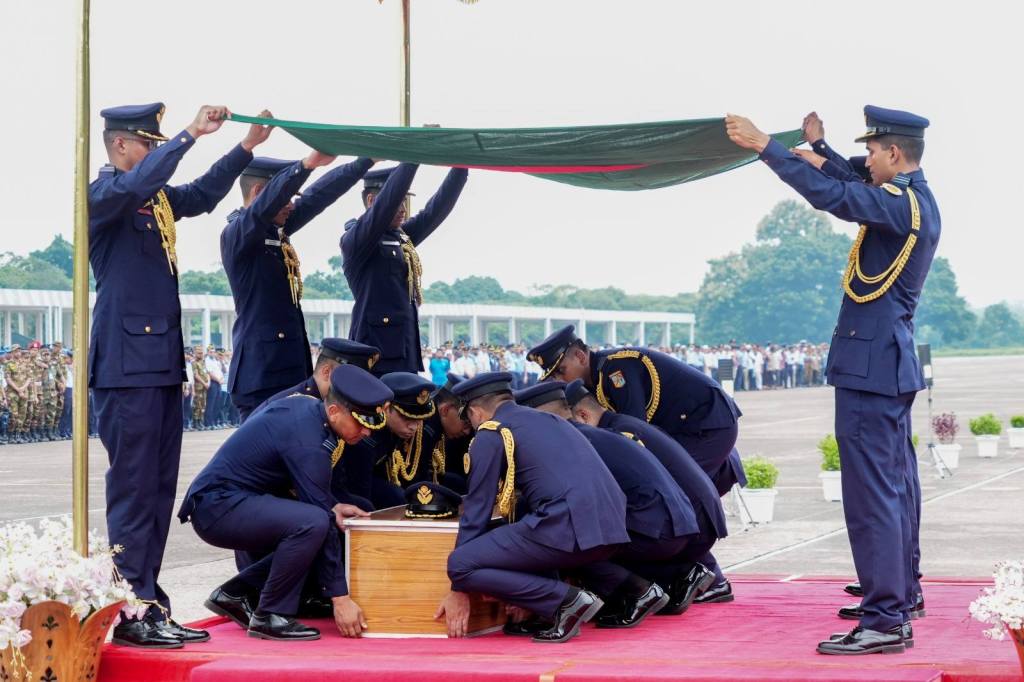
Photo: Bangladesh Air Force
On a fateful September day in 1998, an Air Parabat Cessna 150 lost power mid-flight over Postogola, Dhaka, plunging to the ground with devastating force. Pilot Faria Lara and co-pilot Syed Rafiqul Islam perished on impact.
They had just taken off from Barishal, their sights set on Dhaka, when disaster struck. Moments before the crash, Bangladesh’s first female flight instructor, Lara, sent a haunting “Mayday” call from the cockpit.
Her final words ring in my ears: “I have only a few more minutes left on this earth; we are about to end.” Since then, every training-plane accident dredges up those chilling echoes of her desperate plea.
Fast forward to July 21, 2025—another tragic day. An Air Force F-7 BGI training jet careened into the Milestone School and College‘s Uttara campus in Dhaka at noon, and my mind raced back to Lara’s final moments.
The grim reality washed over me as images flooded social media feeds, taking me back to two previous tragedies: the Nimtoli fire on June 3, 2010, which claimed 124 lives, and the Churihatta blaze on February 20, 2019, leaving 71 dead—countless women and children lost, their lives extinguished in a heartbeat.
Shah Bulbul, the public relations officer for Milestone School, shared the horror that unfolded as students sat in class when the jet struck. With dozens already gone or unaccounted for, the death toll was bound to climb due to the explosion that followed the crash.
Just a month earlier, on June 12, 2025, tragedy struck again when an Air India flight plunged just minutes after takeoff near Ahmedabad, crashing into the dormitories of BJ Medical College. The loss? All 242 souls onboard, alongside five students on the ground.
According to Bangladesh’s Inter-Services Public Relations (ISPR), an F-7 aircraft crashed 12 minutes after takeoff at 1:06 PM. By 4 PM, Brigadier General Muhammad Zahed Kamal, the Director General of Fire Service and Civil Defense, announced that they had recovered 19 bodies from the wreckage.
More than a hundred victims required urgent medical attention, with many suffering from severe injuries and burns. A surge of politicians arrived on the scene, drawing significant criticism for allegedly orchestrating staged “show” visits while a tragedy unfolded.
I stumbled upon a heart-wrenching photo of a child left as nothing but a charred remnant. How many others completely burned to ashes?
The jet crashed into the ground floor of a building adjacent to the school garden, igniting an inferno that firefighters struggled to contain. Soldiers were on the scene before Fire Service and Civil Defense arrived. Disturbing videos showed dazed, burnt children stumbling out, as chaos engulfed the area.
How many more horrifying images will emerge? Nothing compares to the anguished screams of parents searching for their children. At the same time, hospitals call for blood donations as medical staff seek victims’ relatives. Once again, in mid-July, we find ourselves grappling with a heart-wrenching reality.
In the aftermath of this crash, a chorus of voices has risen, urging the addition of blood types and guardian contacts on school ID cards—an essential step toward more efficient identification of victims, a small measure amidst the overwhelming grief.
Professor Md. Sayedur Rahman, the special assistant to the chief adviser of the interim government, has confirmed that seven victims from the recent disaster remain unidentified and require DNA tests for accurate identification.
Meanwhile, dramatic scenes unfolded on social media. Soldiers clashed with the teachers and students of Milestone School, igniting outrage.
A student, Nitul Chowdhury wrote on Facebook, “I led the Rover Scouts team that rushed to the scene just twenty minutes after the impact. We tirelessly recovered twenty-five bodies ourselves, but the officers reported only two or three fatalities. From hospital reports, we knew at least fifty to a hundred lives were lost. When journalists attempted to reveal the truth, the army responded with brutality.”
Nitul explained, “They injured my friend Shafayat, and when my brother Nihad and I tried to help. We also became a target of attack. The situation escalated when army baton-charged our principal, Ziaul Alam Sir, and his vice principals. After a long day, we had to leave the campus quietly.”
As night fell and ambulances continued to work tirelessly at the crash site, frustration among students mounted. How could the Higher Secondary exams still not be officially suspended? Groups began to gather on campus, fueled by anger and disbelief.
On Tuesday, relentless protests surrounded the crash site and extended to the Secretariat. Clashes erupted between determined student demonstrators and law enforcement, creating a palpable sense of urgency.
Around 10:30 AM, a trio of advisors from the interim government—Asif Nazrul (legal adviser), C.R. Abrar (education adviser), and Shafiqul Alam (press secretary)—paid a visit to Milestone School and College.
The students, resolute and unyielding, trapped them until 7:30 PM, demanding six critical points:
1. A comprehensive and accurate list of the deceased and injured, complete with names. 2. Fair compensation for every family affected. 3. A public apology from the army for the assault on teachers. 4. Retirement of outdated, hazardous training aircraft in favor of modern, safer jets. 5. Reform of Air Force training methods to ensure humane and secure procedures. 6. Inclusion of guardian contact details and blood types on all school ID cards.
After 7 PM, the army’s official Facebook page released a statement titled “On the Unintended Incident During Rescue Operations in Uttara,” saying, “A misunderstanding and argument arose between a group of curious onlookers, responsible army personnel, and volunteers, which led to this unintended incident.”
The statement added, “Considering the seriousness of the incident, the Bangladesh Army has launched an investigation.”
Earlier that day, the government confirmed 31 deaths and 165 injuries, with the community demanding justice and accountability. But the delay in announcing the postponement of the Higher Secondary exams prompted demonstrations at the Secretariat, where students demanded the resignation of the education adviser and the secretary.
A seasoned journalist, who arrived at the scene within an hour, exclaimed, “We’ve never faced such obstruction while filming a tragedy.” Echoing that sentiment, another reporter drew a troubling comparison to the infamous Rana Plaza collapse of 2013.
This shared memory seemed to ignite senior journalist Milton Anwar’s frustration, leading him to take to Facebook with a bold question: “By abusing and driving away journalists, what are you trying to hide?”
Amid the chaos, Asif Mahmud Sajib Bhuiyan, an adviser to the Ministry of Local Government, firmly addressed the rumors, declaring that claims of concealed casualty figures are entirely baseless.
Meanwhile, the Inter-Service Public Relations (ISPR) praised Flight Lieutenant Md Towkir Islam Sagar for his heroic maneuvering, steering a stricken jet away from crowded areas to minimize potential disasters.
Yet, living in a dense city like Dhaka makes residents acutely aware of how perilous training flights can be; reports indicate that Towkir was on his first solo mission.
The future of training flights in one of the world’s most populated urban landscapes now hangs in the balance. Politicians and even the Air Force chief have voiced their concerns, but rather than focus on recent comments, we mustn’t forget the haunting echoes of past accidents.
Recall April 8, 2008. An F-7 MB training fighter crashed in Paharipara village, claiming the life of Squadron Leader Morshed Hasan when his parachute failed.
Or June 29, 2015, when another F-7 MB, originating from Zahurul Haque Base, vanished into the Bay of Bengal, leaving Flight Lieutenant Tahmid Rumman missing.
November 23, 2018, saw an F-7 BG crash in the Rasulpur firing zone due to a post-weapons fuel fire, tragically taking the life of Wing Commander Arif Ahmed Dipu.
On June 7, 2005, an F-7 MB clipped a multi-story building at low altitude, but fortunately, no fatalities. Similar crashes have marked the history of this aircraft, with incidents dating back to 1994, 1998, 2003, and 2010—all of which were non-fatal but concerning.
Just last month, on June 10, 2025, a Burmese F-7 crash claimed its pilot. The F-7’s troubled legacy extends beyond national borders, with fatal incidents reported in Zimbabwe, Iran, and Pakistan.
The F-7, also known as the J-7, was developed by China’s Chengdu Aircraft Corporation and Guizhou Aircraft Industry starting in the 1960s.
According to airforce-technology.com, a leading site for news and procurement in the military aerospace industry, the aircraft was designed based on the Soviet MiG-21 model, known as the J-7, and subsequently exported as the F-7. Designations appended letters: “B” for Bangladesh imports, “G” for glass cockpits, and “I” for improved variants.
Bangladesh operates a fleet of over 30 F-7 fighters, including F-7 BGIs, FT-7 MBs, and F-7 BGs. The FT-7 MB joined the ranks in the late 1980s, and in 2006, the nation welcomed 12 F-7 BGs along with four FT-7 BGs. Following a deal in 2011, 16 more F-7s were acquired by 2013.
By 2013, total F-7 production had surpassed 2,400 units. China phased out the F-7 in 2023, transitioning to advanced models like the JF-17 Thunder, J-10, and J-35 fighters. Meanwhile, Pakistan, the other major operator, also plans to retire these aging aircraft.
Citing defencesecurityasia.com last May, multiple Dhaka outlets reported that Bangladesh is now eyeing 16 Chengdu J-10C multi-role fighters to replace its outdated fleet. It is also considering 32 JF-17 Thunder Block III jets.
Their “Milestone Tragedy” report poignantly stated: “In the final analysis, the Chengdu F-7 stands as both a symbol of Bangladesh’s resilience and its limitations—a fast, agile interceptor still guarding its skies, but one that now demands a successor before more tragedy unfolds.”
Defense Security Asia stated that the tragic crash in Dhaka may serve as a watershed moment, prompting deeper reflection on the human and strategic costs of relying on outdated legacy platforms in a region where air dominance increasingly determines national security outcomes.
“As regional rivals expand their force projection and air superiority capabilities, the urgency for Bangladesh to modernize its aerial inventory becomes more acute,” they added.
In the aftermath of the Uttara crash, the ISPR conveyed BAF’s commitment to a comprehensive investigation.
Flight Lieutenant Towkir Islam, who graduated from the 76th BAFA course and served in the 35th Squadron, had accumulated 100 hours on a PT-6 and about 60 hours with the 15th Squadron before this mission.
At his moving funeral, held at the Kurmitola Air Base, Air Chief Marshal Hasan Mahmud Khan vowed to pursue a swift investigation.
“Those responsible will face consequences,” he assured grieving attendees, stating, “Each jet has a defined 30-year service life and is well-maintained according to the manufacturer’s standards. The crashed aircraft, while not old, features outdated technology. We stand firm in our commitment to never compromise on maintenance or safety.
People often recall the film Rang De Basanti when discussing pilots who die pursuing civilian or military flying skills. In the 2006 movie, filmmaker Omprakash Mehra showed how a corrupt defense minister’s cheap parts caused a crash that killed an Indian Air Force flight lieutenant.
To cover up his corruption, the government blamed pilot error—despite the defective plane crashing into a populated area. To understand why Bangladesh’s situation echoes that film, we need to revisit more incidents:
On May 9, 2024, a Yak-130 trainer caught fire and plummeted into the Karnaphuli River near Patenga, Chattogram. Squadron Leader Mohammed Asim Jawad and Wing Commander Suhan Zahurul Haque managed to eject, but tragically, Asim succumbed to his injuries later.
On July 27, 2022, a Bell 206 helicopter made an emergency landing in paddy fields due to engine failure. Two pilots were injured, and Lt. Col. Mohammad Ismail Hossain later died in Singapore, leaving the community in mourning.
In a series of heartbreaking events, we remember June 29, 2015, when a K-8W trainer crashed in poor weather, claiming the lives of Squadron Leader Sirajul Islam and Enayet Kabir Palash.
Just weeks earlier, on May 13, 2015, an MI-17-200 helicopter erupted in flames upon takeoff, resulting in Squadron Leader Shafayat Sarwar’s death after a prolonged battle for survival in Singapore.
Looking back even further, on April 1, 2015, a Cessna-152 flying from Bangladesh Flying Academy also caught fire after takeoff, tragically claiming the lives of trainee Tamanna Rahman and instructor Shahed Kamal—a somber reminder of the risks involved in aviation training.
The toll of these incidents continued with serious crashes, like the L-39 Albatross that went down on April 8, 2012, in Tangail, killing Flight Lieutenant Reza Sharif.
A series of unfortunate PT-6 trainer crashes, starting from October 19, 2002, in Cox’s Bazar that claimed four crew members, to various mishaps over the years—each incident echoes the urgency for safety reforms within Bangladeshi aviation.
Even non-fatal training mishaps make headlines, such as the Yak-130 collision on December 27, 2017, where pilots parachuted to safety. More recently, on January 9, 2021, a Cessna-152 at Shah Makhdum Airport made a gear-up landing without serious injuries, a lucky escape in a history marked by danger.
Historically, the first post-independence crash on October 10, 1972, when a DC-3 training plane went down near Dhaka, set a grim tone for what was to follow.
On August 5, 1984, a Biman Bangladesh Fokker F27-600 crashed into wetlands due to bad weather while flying from Chittagong to Dhaka. Total 49 people died, including Syeda Kaniz Fatema Roksana, the airline’s first female pilot.
On March 12, 2018, US‑Bangla Airlines Flight 211—a Bombardier Q400 captained by Bangladeshi former Air Force pilot Abid Sultan and co‑piloted by Bangladeshi Prithula Rashid—skidded off Kathmandu’s Tribhuvan International Airport runway, crashed into a nearby slope, burst into flames, and killed 51 of the 71 people aboard while injuring the rest.
[First published from Dhaka, Bangladesh: July 22, 2025, 8:57 PM. Author: Journalist, Filmmaker, Musician]
 One-man Newsroom
Leave a comment