

Muhammed Aziz Khan and his wife, Anjuman, hold the Bangladesh flag at a multinational event. Shared on August 3, 2024, and subsequently reshared on April 19, 2025, the image signifies the launch of the Anjuman & Aziz Charitable Trust, which focuses on child education, refugee needs, and addressing malnutrition. The second post pays tribute to Nelson Mandela’s ideals of reconciliation and unity. [LinkedIn/Muhammed Aziz Khan]
Correction: The cover photo caption has been revised at 9:55 PM (July 28, 2025), as it inaccurately stated that the photo was at a UN event on Nelson Mandela International Day, July 19, 2025. The exact date and context are still unverified.
Muhammed Aziz Khan has astutely leveraged the prestige of Singapore General Hospital (SGH) to rebrand himself as a compassionate figure in the Milestone Tragedy, despite his lack of involvement in organizing or funding the deployment of its burn-care teams. SGH’s Burn Centre is Southeast Asia’s premier specialized burn facility, with protocols in place for rapid deployment and remote collaboration. By referring to SGH as “my hospital” in LinkedIn posts, Khan associates his brand with an institution universally respected for its clinical excellence.
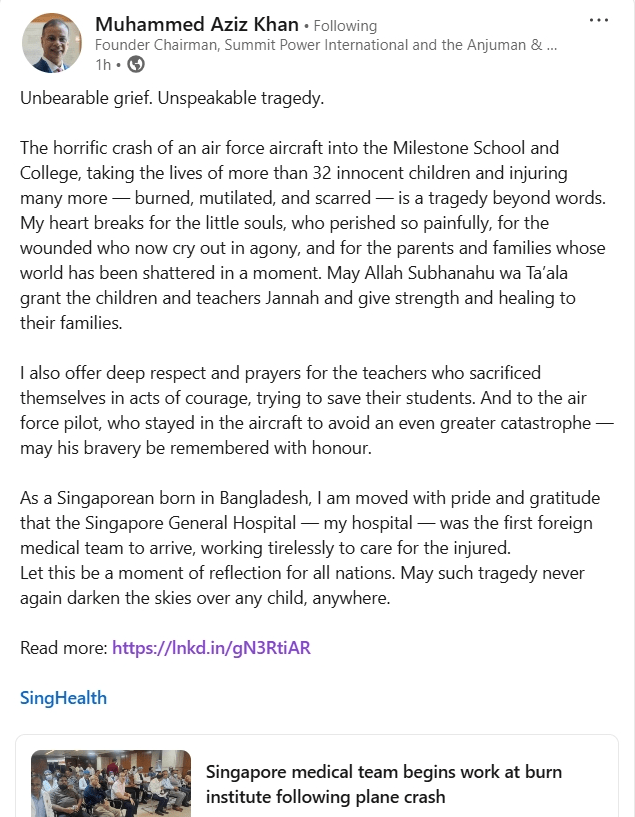
Muhammed Aziz Khan’s July 24 LinkedIn post mourning the Milestone Tragedy and lauding “my hospital,” Singapore General Hospital, as the first foreign burn‑care team on the ground. [LinkedIn/Screen Grab]
In 2020, during the early COVID-19 wave in Singapore, Aziz Khan and his wife donated SGD 100,000 (~USD 75,000) to Sing Health to support migrant workers—particularly Bangladeshi nationals—who faced isolation and financial challenges due to medical expenses in dormitories. For his efforts, Muhammed Aziz Khan was awarded the Public Service Medal (COVID‑19) by the Prime Minister’s Office of Singapore in October 2023. Khan also donated USD 300,000 over three years to the National Heart Centre Singapore (NHCS).
But Aziz Khan does not hold any official position at SGH or NHCS. His connection is philanthropic, centered on supporting the health of migrant workers and conducting institutional research, as reflected in both direct donations and engagement with Singapore’s healthcare framework.
When the Bangladesh-born Singaporean tycoon took to LinkedIn and Facebook on July 24, his words were poignant: “Unbearable grief. Unspeakable tragedy.” He lauded SGH—”my hospital”—for dispatching the first foreign burn‑care team after a Bangladesh Air Force jet crashed into Milestone School and College, killing 32 (now 36) and wounding over 160. By reframing SGH’s institutional aid as a personal intervention, he blurs the line between genuine solidarity and image‑making. He timed his posts to coincide with each new wave of SGH support—first the initial team, then a second contingent—ensuring that every positive development in the relief effort became an opportunity to spotlight his name alongside SGH’s.
Aziz Khan’s LinkedIn update announcing the arrival of Singapore’s second burn-care team in Dhaka, linking to Prothom Alo’s report on the Milestone Tragedy response. [LinkedIn/Screen Grab]

I reached out to Aziz Khan via email and Facebook message to clarify his role in deploying Singaporean medical teams after the Milestone Tragedy. I intended to ask him directly about a couple of things: Who manages his LinkedIn and Facebook profiles—does he handle them personally, or is it a team effort? Additionally, when he referred to Singapore General Hospital as “my hospital,” did he mean it literally or figuratively?
Khan didn’t respond to my messages, but a Summit Group official later (July 27) informed me via WhatsApp that he had added a clarification to his posts. It reads: “When I said ‘my hospital’ about the Singapore General Hospital, I meant it like we say ‘my country’ or ‘my school’ – out of pride and affection, not ownership. Just proud to see Singapore General Hospital leading with care.”
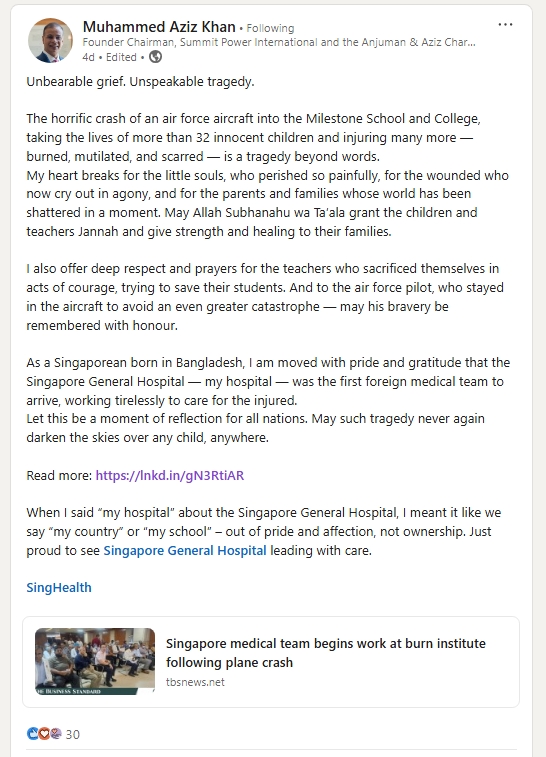
Muhammed Aziz Khan’s July 27 LinkedIn clarification: “‘My hospital’ was a figure of speech—like ‘my country’ or ‘my school’—expressing pride and affection for SGH, not ownership.” [LinkedIn/Screen Grab]
For many Bangladeshis, Khan’s heartfelt message rings hollow against a backdrop of corruption allegations and frozen assets, or further inflames the debate over privilege, power, and accountability in Bangladesh’s business-political nexus. His recent public posts reveal a calculated effort to reposition himself in sync with Bangladesh’s shifting political climate.
On August 24, 2024, he shared two major international stories—one from Reuters and another from Bloomberg—along with a personal note that distances him from the fallen Hasina regime. Referring to the months-long uprising that led to Sheikh Hasina’s ouster as “this crossroads of Bangladesh’s youth rising,” Khan subtly endorsed the mass youth-led movement without naming the former prime minister.

[Facebook/Screen Grab]
He praised the new interim government, led by Nobel Peace Laureate Dr. Muhammad Yunus, portraying it as a force for “development, equality, and job creation.” By invoking Yunus’s international stature and clean reputation, Khan appears eager to align himself with the new order. This statement—strategically timed and internationally framed—suggests Khan is not only looking to revive investor confidence but also to secure moral capital by embracing the reformist momentum that ushered in the post-Hasina transition.
I also reached out to Shafiqul Alam, the press secretary to the interim government’s chief adviser, via WhatsApp to request clarification on the extent of private sector involvement, if any, in arranging or funding the medical teams from SGH. Specifically, was Aziz Khan ever approached or authorized to facilitate this deployment, or was it managed entirely through government channels?
I have not received a response from him either. However, official statements confirm SGH’s teams arrived under a long‑standing government Memorandum of Understanding (MOU) with Dhaka’s National Institute of Burn and Plastic Surgery (NIBPS), not through any private sponsor. At a press briefing on July 22, Dr Md Sayedur Rahman—Special Assistant to the Chief Adviser—stressed that the Singapore team’s arrival was entirely under an existing MoU between the NIBPS and SGH.
Khan’s LinkedIn and Facebook posts do credit the doctors risking their lives, but they also serve as a carefully orchestrated reputation rescue. True solidarity in a disaster demands transparent action: donating directly to survivor care, collaborating openly with local agencies, and acknowledging institutional frameworks rather than cloaking them in personal branding.
However, his actions have not gone unnoticed by the Bangladeshi public, who view him not as a benevolent benefactor but as a ‘power sector mafia’ who ‘looted’ the country’s wealth before fleeing to Singapore. So, anyone can accuse Aziz Khan of exploiting the Milestone Tragedy for image rehabilitation, citing his political patronage under Sheikh Hasina’s Awami League and the ongoing money laundering trial.
Yet Khan highlights SGH’s deployment as “my hospital sent burn specialists”, without acknowledging that he had zero role in organizing it under the existing MOU. Associating his name with the first foreign relief team embeds his brand in the national trauma narrative, delivering a potent PR boost. Such tactics are not unique to Bangladesh but rather reflect a broader trend of corporate actors exploiting national trauma for their reputation management.
Posting on LinkedIn ensures that business journalists, policymakers, and opinion leaders see—and share—his narrative. The professional platform’s algorithms favor content from high‑profile executives, further magnifying his message. By co‑opting SGH’s reputation, Aziz Khan isn’t just expressing sympathy—he’s conducting a strategic reputation rescue. By opening with shared grief and closing with “a Singaporean born in Bangladesh,” Khan taps into deep wells of national solidarity. This dual identity allows him to claim a unique stake in both countries’ pride, making his message resonate on an emotional level.
Public opinion in Bangladesh has a significant impact on legal proceedings, with judicial outcomes often reflecting popular sentiment. Summit Power International’s chairman’s reputation is crucial for investor confidence as the company seeks foreign capital, and presenting himself as a caring national figure could enhance his influence in both court and business.
Since March 9, a Dhaka court has frozen 191 bank accounts belonging to him and ten family members—holding roughly BDT 417 million (approximately USD 3.40 million)—on charges of money laundering and holding disproportionate assets. In May, another order froze €4.11 million of Luxembourg investments; investigators have also moved to confiscate land assets in Dhaka.
The Summit Group strongly challenges the allegations. As of mid‑2025, there are no known criminal convictions or resolved charges against Muhammed Aziz Khan. All cases remain in the pre-trial phase, stemming from probes initiated after Aziz Khan’s name surfaced in the Panama Papers and subsequent inquiries by the National Board of Revenue (NBR).
Aziz Khan became one of Singapore’s wealthiest individuals by building a diversified business empire rooted in Bangladesh’s power and infrastructure sectors—and then relocating his corporate base to Singapore. As a Forbes‑listed billionaire (US$1.1 B) with contested political connections and ongoing asset‑freeze orders, his “my hospital” narrative may satisfy international audiences but risks inflaming domestic skepticism, especially when the MOU details and court documents are publicly accessible.
Forbes first included Khan in the Singapore Rich List in 2018, where he ranked 34th with a net worth of $910 million. His wealth increased steadily over the years, growing from $955 million in 2020 to $990 million in 2021. In 2022, he became a billionaire with an approximate net worth of $1 billion, and by 2023, his wealth reached $1.12 billion. In recent years, he has maintained a ranking around 41st to 42nd among Singapore’s wealthiest individuals. As of June 6, 2025, Forbes lists his net worth at approximately US$1.1 billion, ranking him among the top 3,000 billionaires globally and among Singapore’s wealthiest individuals.
Both Aziz Khan and Sheikh Hasina hail from Gopalganj, creating a regional nexus. That locale is known as Hasina’s political heartland, strengthening local influence and possibly facilitating connections. Muhammed Aziz Khan’s elder brother, Lt. Col. (Retd.) Faruk Khan, is a longtime member of the Awami League Presidium and a former cabinet minister. Faruk has served multiple parliamentary terms and held portfolios including Commerce and Civil Aviation during Sheikh Hasina’s tenure in power.
Aziz Khan was the “power kingpin under Hasina’s reign”—a close confidant with influence in energy sector policy that favored the Summit Group. Through his group, he established more than 20 power plants (~3,000 MW of capacity), notably during Hasina’s 15 years in power. Investigations link Summit’s rapid rise to government support from senior Awami League officials, including ministers and advisers under Hasina’s administration, who allegedly promoted favorable policies and contracts.
Direct policy mechanisms, such as the Quick Enhancement of Electricity and Energy Supply (Special Provision) Act, 2010, enabled the Summit to secure lucrative power contracts without competition and import equipment with tax exemptions. The LNG terminal at Maheshkhali, fuel oil contracts, and fibre-optic telecom projects were awarded by the Awami League, with allegations of non-competitive bidding and favoritism towards the company.
Aziz Khan’s brother Farid Khan, also a vice-chairman of Summit Communications, is a known close associate of Sajeeb Wazed Joy, Sheikh Hasina’s son and former ICT adviser. The friendship granted Summit informal advantages in telecommunications licensing and deals.
In connection with a 2007 case, Sheikh Hasina and top Awami League figures (including energy advisers such as Tawfiq‑e‑Elahi Chowdhury and Abul Kalam Azad) were accused—alongside Muhammad Aziz Khan and brother Farid—of receiving bribes from Summit Group and others over a power plant project in Khulna.
On July 24, five SGH burn specialists arrived in Dhaka to assist burn victims, following an initial team that began work on July 23. India sent doctors and equipment from Delhi, while China dispatched specialists from Kunming Medical University to support efforts at the National Institute of Burn and Plastic Surgery. These teams reflect strong regional solidarity in caring for the victims.
On the other hand, until Khan channels resources into tangible relief—beyond performative posts—his “my hospital” refrain will remain a cautionary tale of calculated compassion. As Bangladesh mourns its children, the public deserves clarity on who is acting out of compassion and who is acting out of calculation.

Posted February 1, 2023: Aziz Khan poses with Japanese diplomats, joined by his brother, Lt Col (Retd.) Faruk Khan and former Energy Adviser Tawfiq‑e‑Ilahi Chowdhury—both are presently in jail. [LinkedIn/Muhammed Aziz Khan]

Remembering the F-7 Crash Victims: Time for Accountability
Milestone tragedy sparks urgent call to modernize air fleet.

 One-man Newsroom
Leave a comment