

By Newsman, Dhaka, Bangladesh
Talks about Bangladesh’s next national election has ramped up since early August. The interim government (IG) has proposed a tentative schedule for early 2026.
On August 5, Muhammad Yunus, the first Nobel Peace Prize winner to lead Bangladesh, sets the public clock.
“I will send a letter to the Chief Election Commissioner (CEC), so that the Election Commission (EC) organizes the national elections before the next Ramadan, in February 2026,” Yunus said in a televised remark.
This announcement set the timeline that much of the subsequent debate has tracked. The next day, CA’s Press Secretary, Shafiqul Alam, reaffirmed that “no force” could obstruct a February vote.
The media reported that the Chief Adviser’s Office (CAO) had formally transmitted a letter requesting EC preparations for a February 2026 poll.
“Despite several challenges surrounding the February election, our preparations are moving forward, CEC AMM Nasir Uddin said.
Domestic actors, besides the IG, the EC, the Army, and the Bangladesh National Party (BNP), which is likely to win the upcoming election, are actively discussing the voting process.
“Holding elections is the only way to restore the political rights of people and resist fascism,” Tarique Rahman, acting chairman of the BNP, said on August 19, in virtual remarks from London.
BNP leaders also called on the EC to ensure fairness in polling-station mapping, demanding the cancellation or redrawing of biased centers and guarantees of neutrality. The Awami League (AL), whose activities are banned and excluded from the election campaign, is voicing its opinions.
On August 19, Sheikh Hasina, former Prime Minister and AL leader in self-exile in India, called for Muhammad Yunus to resign as CA to IG before the elections. Also on August 5, Hasina issued an “open letter” saying she “never resigned.”
On the other hand, smaller parties such as the National Citizen Party (NCP) and Bangladesh Jamaat-e-Islami are publicly expressing their views on the shape of reforms, electoral design, timing, safeguards, and format of the election.
Specifically, the NCP stance remains a potential disruptor to a straight February 2026 schedule. Their leaders, a political party formed by young revolutionaries who led a mass uprising that toppled the Hasina-led government, are now pushing for constitutional change.

Netra News Exposes Army-NCP Tensions in Bangladesh
Independent media vital for Bangladesh’s democracy amid military tensions.


NCP’s Stand Against Military Influence in Politics
AL’s future uncertain amid political turmoil and protests.

NCP: The New Face of Protests to Politics
The youth-led party gained global recognize as a game changer.
They have called for a Constituent Assembly election first, emphasizing that a new constitution must come before any parliamentary poll. “Any election held in Bangladesh must first be a Constituent Assembly election,” declared Nasiruddin Patwary, chief organizer of the NCP, on August 16.
Also, Jamaat has urged the CA to dialogue with political parties about the upcoming elections, warning that rushing without reforms could strengthen “fascism.”
Syed Abdullah Mohammad Taher, Nayeb-e-Ameer of Jamaat, said on August 17, “Only a free, fair, neutral, and participatory election could free Bangladesh from its grip.”
Jamaat stated that 71 percent of citizens support proportional representation and urged Parliament to implement it.
Later, while virtually addressing a discussion, Tarique Rahman said, “Through the practice of electing public representatives by direct vote, people gain strength in the state and politics.
If the people are not strong, the state and the government cannot be strong.” He added, “In a democratic system, elections are the main way to empower people and ensure every citizen’s political rights.”
On the same day, Army Chief Gen. Waker-Uz-Zaman said, “As the country advances toward elections, the armed forces have made all necessary preparations to support civil authorities…”.
At the Officers’ Address in Dhaka Cantonment, the Army Chief reaffirmed the military’s commitment to professionalism, discipline, and national unity. The Army says it stands ready to assist, Jagonews24 reported.
On that day, BSS reported that Dr. Asif Nazrul, Law, Justice & Parliamentary Affairs Adviser of IG, stated, “The polls will be in February, and the government’s stance on this remains unwavering.”
The Samakal, a leading newspaper in Dhaka, updated on August 20 that the EC will publish the draft list of polling centers on September 10, 2025, according to a letter signed by EC Deputy Secretary Md. Mahbub Alam Shah.
Accordingly, for the 13th National Parliament election, the EC will accept claims and objections against the draft list through September 25, complete disposal (adjudication) of objections by October 12, and prepare and finalize the probable final list of polling centres by October 20.
Meanwhile, practical international engagement is now arriving. The European Union (EU) has pledged an assistance package of around €4 million. It is sending technical experts, a move that turns rhetorical pressure into capacity-building help for the EC.
Michael Miller, EU Ambassador, announced this support package to help the EC “run elections in line with international standards” and said a technical team would visit next month.
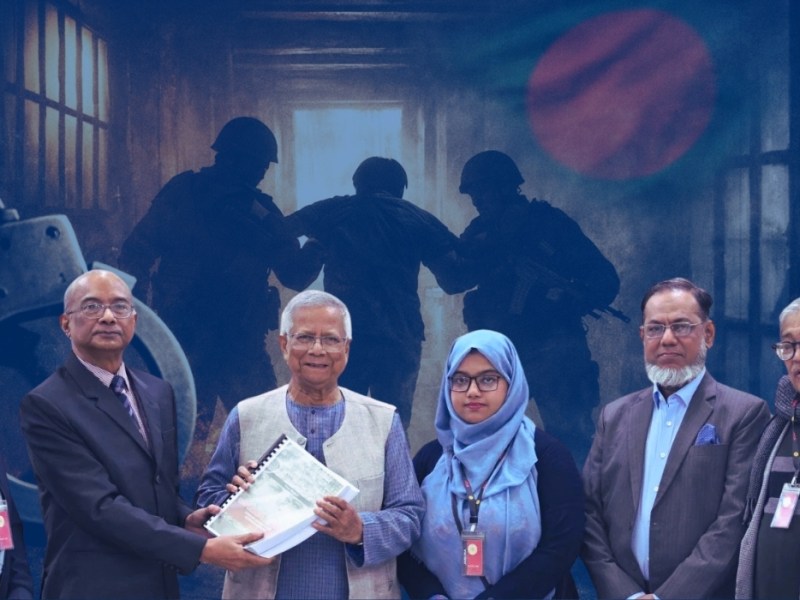
Bangladesh: Where the State Erased Its Critics
Enforced disappearances were systematic and politically motivated.

Erier, on August 12, Amnesty International’s mid-Aug briefing warned the IG that some of its actions had been “inconsistent with the July Declaration” and urged rights protections ahead of the vote.
Reporting reiterates the broader timeline debate that began late 2024 and continued into 2025, noting earlier public statements from CA Yunus that first set an election window between end-2025 and mid-2026.
An August 11 article on a survey conducted jointly by Voice for Reform and the Brac Institute of Governance and Development (BIGD) said, “70% citizens are optimistic about a fair national election.” The Business Standard (TBS) reports the EC is planning for a massive operation: “Over 45,000 polling centers likely for national election.”
On August 16, Election Reform Commission Chairman Dr. Badiul Alam Majumdar highlighted the need for all parties, especially political ones, to act responsibly for a fair election. “It is not possible for the EC alone to organize fair elections. The responsible role of all concerned, including political parties, candidates, voters, civil society, and the media, is essential in this connection,” he said.
 One-man Newsroom
Leave a comment