
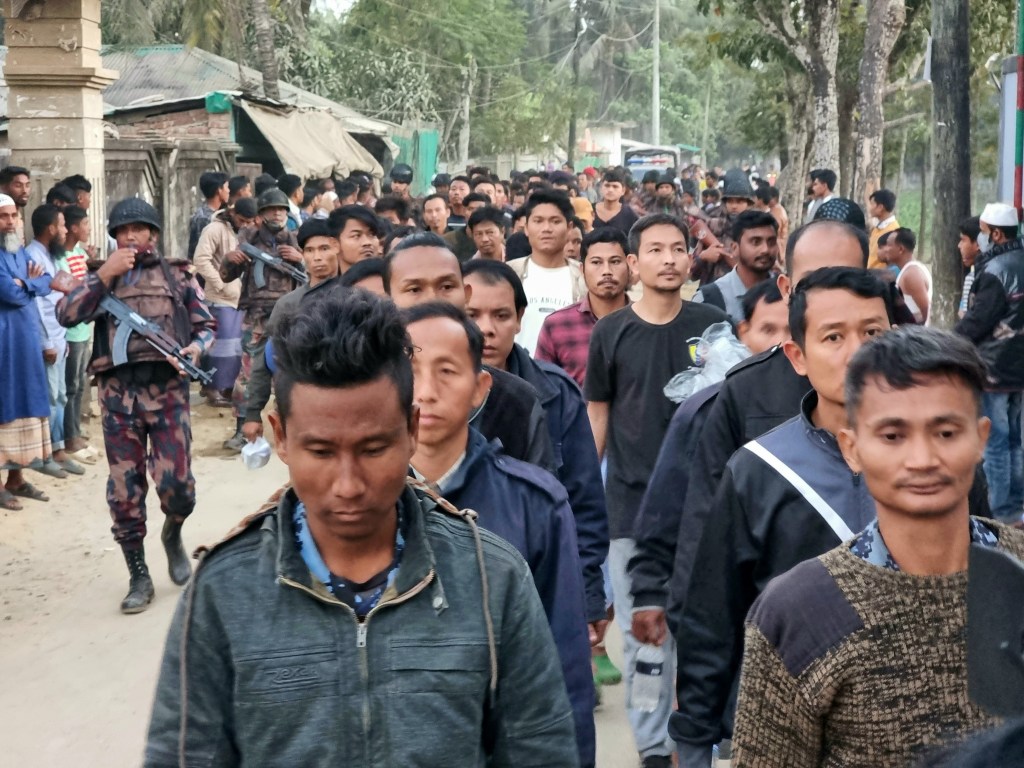
In February 2024, hundreds of military and civilian officials from the junta government fled to Bangladesh for the first time, escaping the attacks of the Arakan Army (AA). In the photo, Border Guard Bangladesh members escort Myanmar citizens to a temporary shelter in Teknaf. In the following months, more military personnel and officials from Rakhine State also sought refuge in Cox’s Bazar. Photo: One-man Newsroom
By Newsman, Dhaka, Bangladesh
Bangladesh and China are agreeing on a pragmatic approach. Dhaka and Beijing signaled that any lasting resolution to the Rohingya crisis must involve the Arakan Army (AA) in ceasefire negotiations and political discussions.
This position has emerged alongside recent reports of abuses by the AA against the Rohingya and rising incidents at sea and along the border are increasing security risks for Bangladesh.
During the Rohingya Genocide Remembrance Day commemoration in Cox’s Bazar on August 25, Chief Adviser Professor Muhammad Yunus said, “We urge the Myanmar authorities as well as the AA to ensure the safety, security, and livelihood of the Rohingyas.”
“They must also allow internally displaced persons from camps in central and northern Rakhine to return home as soon as possible,” he added. “We urge all to calibrate their relationship with Myanmar, the AA, and other parties to promote an early resolution of this crisis.”

Rohingya Voices Amplified at the Cox’s Bazar Conference
“We became refugees unwillingly. We never wanted this life.”

B’desh on High Alert, Clashes in Rakhine Trigger New Influx
Rohingya cannot return as the crisis worsens, the UN warns.
Chinese Ambassador to Bangladesh Yao Wen said the most urgent priority is halting any further influx into Bangladesh, arguing that requires a ceasefire between Myanmar’s military and the AA.
“We understand the AA controls over 80 percent of the territory of Arakan state and still wants complete control. But who provides them with weaponry, finance, and intelligence? China does not play any role; we don’t give anything to either the Arakan Army or the Myanmar government,” he said.
A report by The New Humanitarian on August 27 alleges that the AA has detained Rohingya individuals and used coercive practices.
If verified, these claims raise serious humanitarian concerns about engaging with the AA, as they support Dhaka and Beijing‘s view that the group’s control in Rakhine is vital for protection and the return of displaced individuals.
They mentioned that, over the past decade, the AA, estimated to have some 30,000 soldiers, has expanded its control to 14 of Rakhine’s 17 townships as it seeks greater autonomy from the Myanmar government.
The Prothom Alo, a Bengali daily, reports on August 27 that at least 58 fishermen have been kidnapped over the past 22 days in the Naf River and nearby waters by gunmen identified as members of the AA.


Dr. Yunus’ Diplomatic Push: Key Meetings with Xi and Modi
Bangladesh strengthens ties with China and India for stability.
On August 26, The Business Standard reported that 46 fishermen had been kidnapped, with at least 39 of those abductions occurring in the last four days alone. On that day at 11 AM, six fishermen and their trawler were taken.
Separately, on August 26, the BGB seized two G3 rifles, one MA-1 rifle, one LM rifle, eight magazines, and 500 rounds of ammunition during a raid at Khurer Dwip, Teknaf, following gunfire from smugglers who then escaped into Myanmar.
BGB suspects the cache was being stockpiled for criminal or militant activity and is investigating the source networks.
Sharif Khiam Ahmed, founder of One-man Newsroom and a journalist with nearly ten years of experience on the Rohingya crisis, said, “Authorities haven’t linked the seizure to the AA, but its timing aligns with AA-related abductions, highlighting a conflict zone with illegal arms and non-state actors, emphasizing the urgent need for ceasefire talks with the AA.”
“The reported abuses, ongoing kidnappings, and arms flows underscore the shared policy assumption of Dhaka and Beijing; stabilizing Rakhine and protecting civilians requires enforceable agreements with the AA on security, humanitarian access, and repatriations,” the journalist added.

Understanding ARSA’s Role in Rohingya Violence and Displacement
Jununi’s arrest highlights urgent calls for justice and accountability.

Who is Ataullah Abu Ammar Jununi? Key Facts Revealed
The arrest that shook ARSA: Bangladesh captures its elusive leader.
 One-man Newsroom
Leave a comment