
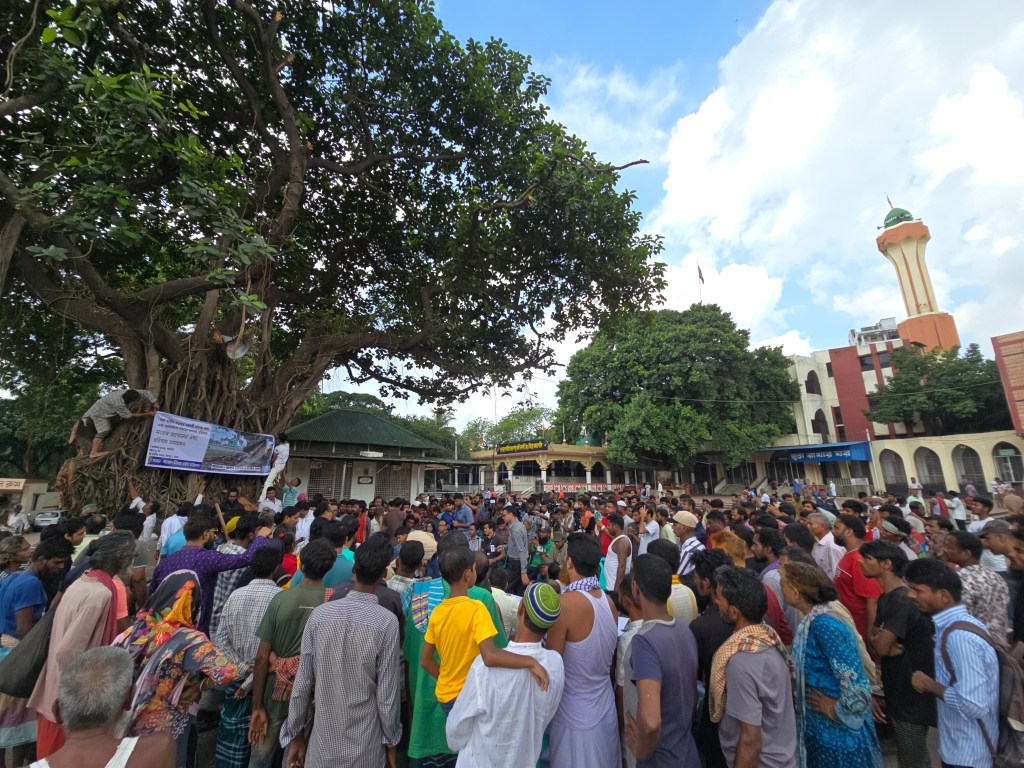
Devotees, bauls, faqirs, and poets gather at the shrine of Hazrat Shah Ali Baghdadi (R.A.) in Mirpur to protest the pruning of an ancient banyan tree, calling it an attack on communal spiritual space. October 4, 2025. Photo: Sharif Khiam Ahmed
By Sharif Khiam Ahmed, Dhaka, Bangladesh
A protest gathering and press conference held at the shrine of Hazrat Shah Ali Baghdadi (R.A.) in Mirpur issued a significant warning to the interim government on Saturday.
Senior poet and political thinker Farhad Mazhar called upon officials to take measures to protect folk-spiritual centers from forces that are antagonistic to shrine-based devotion. “I’m warning this government, if you want the social stability, you keep speaking about, remember: the only public space that sustains that stability is the mazar,” he said.
“We have no truly public cultural centers. Poor people are often unable to enter these so-called cultural venues. The mazar is a people’s democratic institution, serving as a meeting place for people of different views,” he added, “Without such gatherings, how can democracy exist?”
The event, organized under the banner of “Mazarer Bhaktabrindo O Nagorik Samaj” (Devotees of the Shrine and Civil Society), was convened to protest the recent pruning of an old banyan tree within the shrine compound.
Devotees expressed that this is part of an escalating campaign that poses a threat to the public spaces dedicated to Bangladesh’s folk spirituality. The tree sheltered generations of rituals. They served as a gathering place for devotees, bauls, faqirs, pagols (devotional practitioners often referred to as “madmen” in local traditions), and other spiritual communities.
Speakers described the cut branches as an attack on memory and devotion. “This banyan tree is not just a tree,” Farhad Mazhar said. “It carries memories, devotion, spiritual lineage, the shelter of the mad and the mystic. It shelters birds, geckos, snakes, and leeches; it is their home. The way they cut this tree is a serious offense. It is an assault on the heart of a nation.”
“Who gave you the courage to cut this tree? On whose order was it done? As the guardian of this shrine, the Deputy Commissioner (DC) must answer as well,” he added, noting that three advisers of the current government had spoken under the same tree just last April.
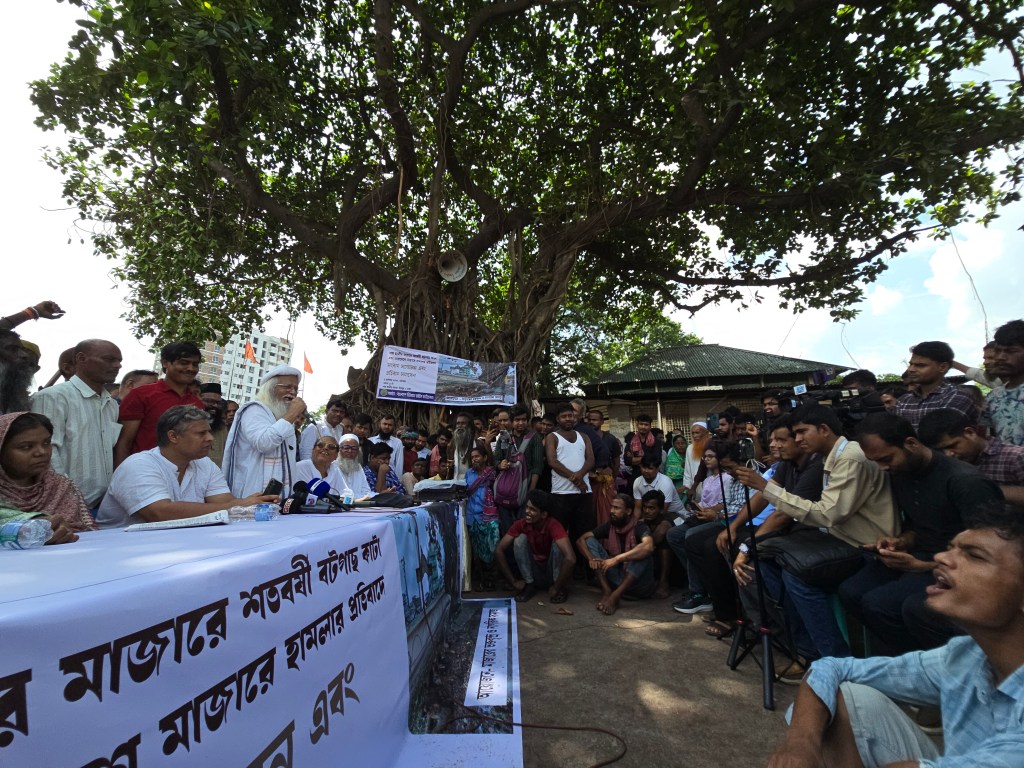
Speakers claimed that the shrine management committee ordered this act. Representatives from the shrine’s pagol and faqir communities, Mohammad Nasir Hossain and Tanvir Hossain Suman, stated that the removed branches had been home to thousands of birds.
They also reported that the habitat of a rare gecko species, known as the tokay, has been destroyed, according to local beliefs. After the management cut the branches of the tree, they could no longer hear the call of the tokay gecko.
In that context, Farhad said the tokay’s call is also closely tied to spirituality. Devotees refer to this sound as zikr, and just as ordinary worshippers prioritize the five daily prayers, these practitioners consider the daily practice of zikr their primary act of worship.
Farhad said, “Mr. Manager, we’re here now. Where are you? Come here; we need to talk to you. Where did you sell that tokay? Don’t think you’ll get away with this. We’ve already informed the government that the tokay is a red-listed, nearly extinct species in Bangladesh. By destroying its habitat, you’ve committed a criminal offense. And for that, you will face trial.”
“Who gave you the courage to cut this tree? On whose order was it done? As the guardian of this shrine, the Deputy Commissioner (DC) must answer as well,” Farhad added, declaring that “such people have no right to be in charge of a shrine.”
Baul mystic Maharaj Abul Sarkar said the relationship between mystics and trees in Bengal is profound. “If the manager, even the DC, is involved, none will be spared. Today they cut trees; tomorrow they’ll demolish shrines,” he said, accusing shrine authorities of increasingly restricting traditional devotional practices.
He emphasized that trees and mystics in Bengal share a deep bond, adding that the current shrine committee had earlier banned the lighting of candles and incense at the base of another sacred banyan tree near the rauza (tomb), known locally as the Sinni tree.
According to popular belief, this tree sprouted from the walking stick once used by Hazrat Shah Ali Baghdadi (R.A.). For generations, devotees had lit candles and incense beneath it to make vows (manat). Although the authorities later placed a large metal tray nearby for this purpose, devotees see the change as an assault on a centuries-old spiritual practice.
Speakers alleged the shrine’s mosque imams were complicit in curbs on ritual practice, noting that some imams “preach against lighting candles and vows” while still drawing salaries from shrine funds.
“They are biting the very hand that feeds them. They preach against lighting candles, against vows, yet they draw their salaries from the shrine’s fund. Remove all individuals who oppose the shrine. Those who do not support the shrine are not permitted to remain on the premises. Only those who stand with the shrine should manage it,” stated Abul Sarkar.
Organizers accused managers and several employees of harassing pagol and faqir devotees and obstructing their devotional songs. The platform noted that five months earlier, Mostofa Sarwar Farooki, the interim government’s cultural adviser, visited the shrine and urged authorities to respect the mazar and refrain from banning musical gatherings.
Despite that appeal, the platform said, sermons have since been held on the shrine grounds portraying music as antithetical to Islam and the Qur’an, a development devotees say is spreading nationwide.
They also urged mystic communities to unite against drug use and trafficking inside shrine precincts. Farhad Mazhar vowed to remain vocal and active in opposition to such groups. However, he noted, “Unless the environment changes, neither the DC nor the government will listen to me.” He also called on mystics and devotees to unite against drug use and trafficking within shrine premises.
Mohammad Romel, a poet and filmmaker who moderated the meeting, framed the issue as both political and cultural: “Shrines, dargahs and akhras of pirs, murshids, faqirs and saints are socially, culturally and politically vital.”
“They arise from a longing for devotion and a relationship with others. But since the fall of the fascist regime, these public spaces have been systematically attacked one after another across Bangladesh,” he added.
After the press conference, devotees and faqirs blocked the shrine’s administrative office. The manager, Morshed Alam, was unreachable by phone, and no staff were present on the premises. Then, organizers called for the removal of “anti-mazar” elements from shrine administration.

The Shah Ali protest highlights rising tensions over control of shrine spaces, which devotees view as vital public cultural arenas in Bangladesh. Protesters have called for better security for shrines and akhras, as they face growing threats amid the repression of mystics and traditional musicians.
On January 18, 2025, the Chief Adviser’s Press Wing announced that police received reports of 44 attacks on 40 shrines since August 4, 2024. The interim government is enforcing a “zero-tolerance” policy and has ordered investigations.
 One-man Newsroom
Leave a comment