
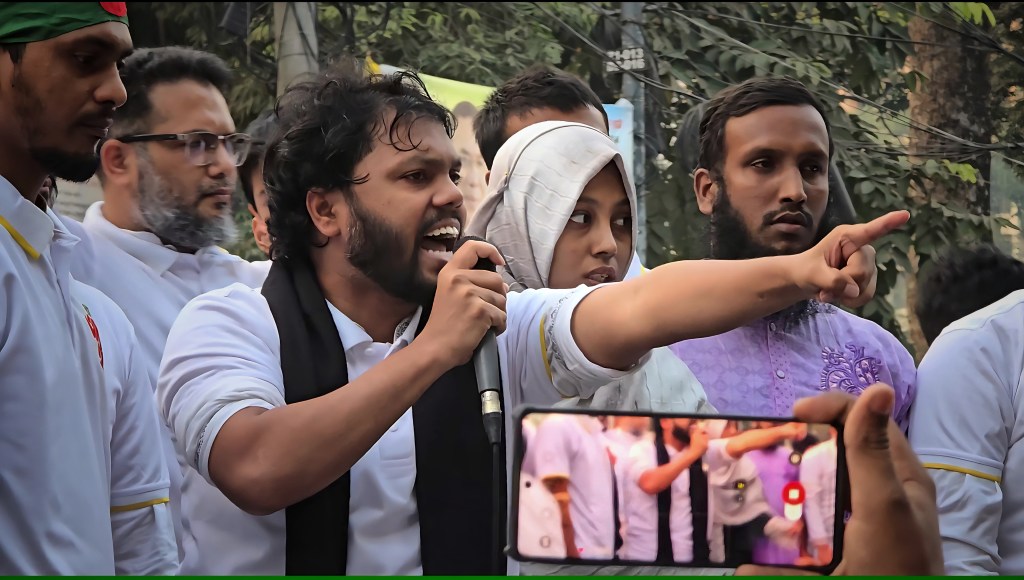
Sharif Osman Hadi is seen with fellow fighters at an event in Shahbag, Dhaka, on November 26, 2025.
Photo: Sharif Khiam Ahmed/One-man Newsroom
Newsman, Dhaka
On December 12, at around 2:25 PM, two gunmen on a motorcycle targeted Sharif Osman Hadi, a 32-year-old leader of the Inqilab Moncho and a key voice for anti-Indian sentiments following last year’s student-led uprising that successfully removed Sheikh Hasina from power.
This alarming attack took place on Box Culvert Road in the Bijoynagar area of central Dhaka, highlighting the ongoing threats faced by prominent activists in the region. Hadi survived the initial attack but was flown abroad for treatment. On December 18, He died in a Singapore hospital.
Within hours of the news reaching Dhaka, protests surged, and two leading newspapers’ offices in Karwan Bazar were vandalised and set alight late that night. Protesters have targeted Prothom Alo and the Daily Star by labeling them pro-India.
The unrest in Bangladesh has raised concerns among civilians, as a single political killing has rapidly escalated into a broader crisis impacting law and order, press freedom, and foreign relations. Mahfuz Alam, another youth leader opposing India, spoke to journalists at Shahbag, stating that the killers of Hadi must be expelled from India immediately.
“Our primary demand is clear; we will not establish normal relations with India until our demands are satisfied,” Mahfuz emphasized. “We want to communicate to India that it must pay attention to us. These games and theatrics need to end. If they persist, just as our sleep has been disturbed, we will make sure theirs is affected too.”
Primarily, the protests clustered around Shahbag and Dhaka University, where organisers staged rallies and issued ultimatums. In the small hours of December 19, a contingent pressed into Karwan Bazar. It attacked the offices of Prothom Alo and The Daily Star.
Journalists reported being trapped on rooftops as attackers smashed glass, dragged furniture into the street, and set fires outside the buildings; firefighters later doused the flames.
The Business Standard’s field reporting documented the sequence in real time: protesters reached The Daily Star around 12:15 AM; a fire service crane was deployed at about 1:40 AM to rescue staff; firefighters were still dousing flames near 2:45 AM.
Nurul Kabir, editor of the English-language daily New Age and president of the Editors’ Council, was harassed and physically jostled by a group of angry protesters. Kabir rushed out, hearing about attacks and arson at Prothom Alo and The Daily Star.
On his way to the Daily Star, protesters blocked his path. When the army tried to escort him through the crowd, the protesters reacted aggressively. They accused him of being an “Awami League collaborator.”
On the same night, around 1:30 AM, a group of protesters attacked the residence of Dr. Rajeev Ranjan, the Indian Assistant High Commissioner in Chattogram. Video circulating online showed stones thrown at the mission’s compound; authorities rapidly moved to secure diplomatic sites.
Earlier, at around 11:30 PM, Bangladesh’s interim chief adviser, Muhammad Yunus, declared a day of mourning and urged calm. “This is an irreparable loss for the nation,” Yunus said, promising a full investigation.
Later, the UN human rights chief expressed concern over the killing of Bangladesh student protest leader Sharif Osman Hadi and called for a prompt and impartial investigation.
“I urge the authorities to conduct a prompt, impartial, thorough, and transparent investigation into the attack that led to Hadi’s death, and to ensure due process and accountability for those responsible,” UN rights chief Volker Turk said in a statement.
Osman Hadi gained international attention for criticizing India’s influence in Bangladesh and the Awami League supporters. Often labeled an “anti-India” youth leader, his rhetoric mixes nationalism with a confrontational style. This public persona explains the immediate anti-India slogans at rallies following his shooting and the quick diplomatic response that ensued.
Swarajya, a media outlet from Tamil Nadu, India, reported that, “Chief Adviser Yunus walked a careful line in his televised address announcing Hadi’s death. He called Hadi a ‘fearless fighter’ and ‘immortal soldier in the struggle against fascism and hegemony’—language that validated the anti-India narrative while stopping short of explicit accusations against Delhi.”
In a news article, with the headline “A ‘Martyr’ For ‘Greater Bangladesh’ Inflames Tensions with India,” they wrote, he (Hadi) positioned himself as a defender of Bangladesh’s sovereignty against what he called “Indian hegemony.“
Swarajya mentioned, “He was not subtle about his ambitions. Shortly before his death, Hadi shared a map on Facebook depicting a ‘Greater Bangladesh’—a provocative vision encompassing not just the existing nation but India’s seven northeastern states, West Bengal, and parts of eastern India.”
Swarajya staff added, “This irredentist concept has deep roots. It traces back to the failed 1947 proposal for a ‘United Bengal’ by the last British Bengal premier, Huseyn Shaheed Suhrawardy.”
Following the attack, Hadi’s family informed reporters that he had received multiple death threats in the months prior, some of which allegedly came from international phone numbers.
“Patriots cannot live in this country. India won’t let him live,” Masuma Begum, Hadi’s sister, said, “He writes against India; he writes for Bangladesh.” Hadi is the kind of patriot who is always ready to sacrifice his life for the country, Masuma told journalists.
She added, “Hadi has many enemies due to the presence of numerous RAW operatives and Awami League activists in the country.” Earlier in November, Hadi shared on Facebook that he received threats from over 30 domestic and foreign numbers, including intentions to kill him and harm his family.
Indian authorities have remained silent on the allegations, and Bangladeshi officials have not confirmed foreign involvement in the attack. However, the assassination of Hadi has heightened anti-India sentiment in Bangladesh, reflecting the deterioration of bilateral relations since Sheikh Hasina’s ouster in August 2024.
As Bangladesh moves toward a politically uncertain period, the handling of the Hadi case and its fallout is likely to be closely watched both at home and abroad. For now, investigators say the focus remains on identifying Hadi’s attackers and determining the motive behind the killing.
“The priority is to establish the facts,” a senior police official said. “Speculation only makes the situation worse.” Police and Rapid Action Battalion (RAB) teams said they recovered leads: a rental car used by the alleged prime suspect the day before the attack and, subsequently, at least two arrests or detentions linked to the case.
Investigators said forensic tracing of phones and CCTV was underway. Security forces have arrested the parents of the main accused in the case, according to a RAB statement.
Bangladeshi law enforcement agencies have also said that the two main accused have fled to India. The Border Guard Bangladesh (BGB) has also arrested two brokers who helped them cross the border illegally.
Beginning on December 12, speakers and organizers at various protest platforms and significant rallies in Dhaka framed the shooting within a larger context of foreign interference and domestic conspiracies. Some participants called for strict measures if the Indian authorities failed to surrender the accused individuals.
Tensions escalated further after Bangladeshi political leader Hasanat Abdullah made remarks referencing India’s northeastern region, known as the ‘Seven Sisters,’ suggesting that instability in Bangladesh could have repercussions there.
India’s Ministry of External Affairs (MEA) summoned the Bangladeshi High Commissioner in New Delhi on December 17 due to serious security concerns regarding the Indian mission in Dhaka. New Delhi’s move, a formal demarche, pushed the episode into the diplomatic realm.
Assam Chief Minister Himanta Biswa Sarma declared that India will not “remain silent” if its territorial integrity or security is under threat. His comments received significant coverage from Indian television networks.
India also temporarily suspended operations at specific visa centres in Dhaka, citing security conditions, reflecting volatility in India-Bangladesh ties. Protests continued across Bangladesh on December 19, with new demonstrations near the Indian mission in Rajshahi.
It followed an earlier attempt to storm the assistant high commission in Chittagong. Recent protests have also taken place near the Indian high commissions in Dhaka, Chittagong, Khulna, and Rajshahi.
ANI reported, expressing concerns over “anti-India” marches to its High Commission in Bangladesh, as well as marches and sit-in protests near its Assistant High Commissions across the neighbouring country; Congress MP Shashi Tharoor, on December 19, stressed that it is the host government’s responsibility to ensure their safety.
Speaking to reporters, Tharoor said, “The government will have to monitor the situation very carefully. They will certainly, at the level of the High Commission in Dhaka, reach out to the government and the authorities in Dhaka and request that they do whatever they can to calm down the situation.”
“It is not at all welcome that our Assistant High Commission is affected by these protests. It is also the host government’s responsibility to ensure that our facilities are protected and safe. Both sides should have an interest in maintaining a good relationship, and we should work to ensure that,” Tharoor added.
Tripura Chief Minister Manik Saha stated on December 19 that his government is prepared to handle any situation amid ongoing violent protests in neighboring Bangladesh following the death of Hadi.
“All of us know under what circumstances, elected Prime Minister Sheikh Hasina had to leave her country. After Hasina’s ouster, fundamentalists, criminals, and thieves walked free from jails in Bangladesh. What we had anticipated is now happening in the neighbouring,” the chief minister told the reporters.
West Bengal BJP chief Samik Bhattacharya expressed concern on December 19 about the situation in Bangladesh. He stated that “fundamentalists are behind the recent events” in the neighboring country and that they “seem to be in control” of the situation. He noted that the Union government and the Ministry of External Affairs are managing the situation appropriately.
Responding to queries on the Bangladesh situation at a press conference, the Rajya Sabha MP said, “Fundamentalism and radicalism are spreading like cancer in Bangladesh. All the right-thinking people should unite to fight this menace.”
Security at the Bangladesh High Commission in New Delhi has been increased due to violent protests in Bangladesh following the death of leader Sharif Osman Hadi, as reported by a senior police officer on December 19.
Protests in Dhaka featuring anti-India slogans, such as “Delhi or Dhaka?”, reflect concerns about foreign influence during a sensitive electoral period. With a parliamentary election scheduled for February 12, 2026, under an interim government led by Muhammad Yunus, ongoing violence or boycotts by major political groups could jeopardize the election’s legitimacy.
In December, China noted that Bangladesh has announced it will hold parliamentary elections in February, Chinese Foreign Ministry spokesperson Guo Jiakun told a media briefing, commenting on the current situation in Bangladesh, PTI reports. “China wishes Bangladesh safe, stable, and smooth elections and believes that various sectors of Bangladesh will properly advance important political agendas and uphold national solidarity and stability,” he said.
While protests have subsided in parts of the capital, police remain on high alert around diplomatic missions and media houses. Authorities said security had been reinforced at the Indian High Commission in Dhaka following attempts to march toward the compound.
Muhammad Yunus announced that the funeral prayer for Osman Hadi will take place at 2 PM on December 20.
In a post on social media, Yunus stated, “Those planning to attend the funeral prayer for martyr Osman Hadi are requested not to bring any bags or heavy items. Additionally, we would like to inform everyone that flying drones in and around the Parliament House area is strictly prohibited.”

BGB Accuses BSF of Border Killings; Joint Dhaka Talks Yield Commitments
Bangladesh also protests illegal push-ins of Rohingyas.

Bangladesh and India’s Tensions Amid Murshidabad Violence
Dhaka and Delhi Exchange Blame over Communal Unrest.

ISPR Responds to False Claims by India Today on Army Meeting
Bangladesh Army denies coup allegations, reaffirms commitment to security.

Combatting Disinformation: Bangladesh’s Stand Against Indian Media
Army Denies Baseless Coup Allegations.

Yunus and Modi Meet at BIMSTEC: Key Regional Discussions Ahead
Embrace entrepreneurship, create sustainable change—stop job-seeking!
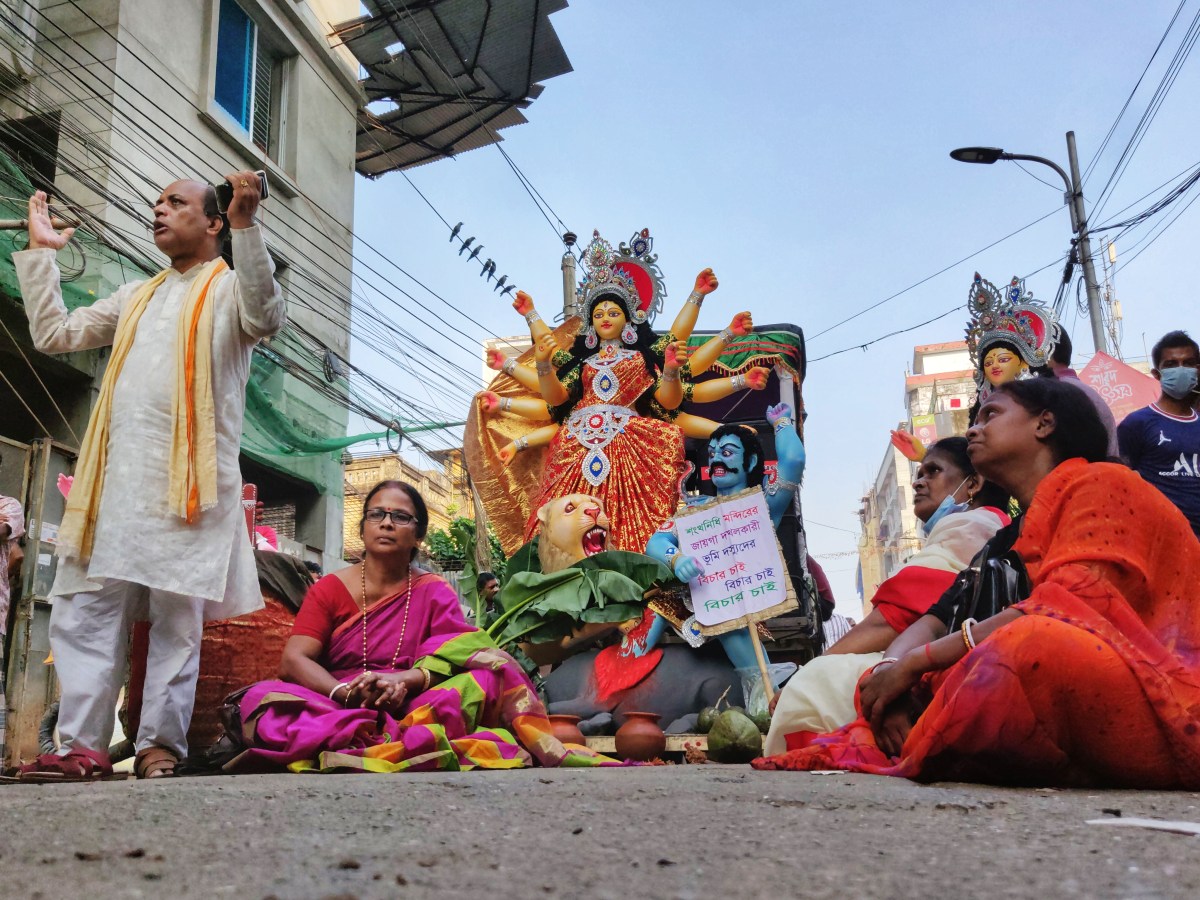
Geopolitical Implications of Religious Intolerance in Bangladesh
US Raises Concerns Over minorities, Dhaka Responds Strongly.
Why Hasina’s fall is a Strategic Shock for India
The way Delhi lost its ‘only trusted neighbor.’
Bangladesh: Where the State Erased Its Critics
Enforced disappearances were systematic and politically motivated.

 One-man Newsroom
Leave a comment