
📷 BSS and One-man Newsroom
Newsman, Dhaka
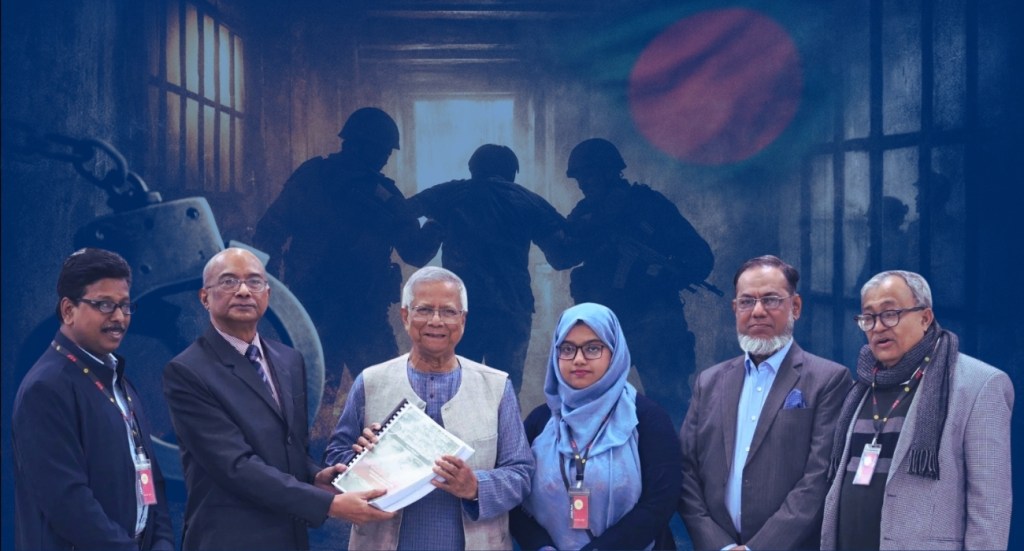
The Commission of Inquiry on Enforced Disappearances (COIED) has submitted its final report to Professor Muhammad Yunus, the Chief Adviser of the interim government, marking a significant institutional acknowledgment of enforced disappearances in Bangladesh.
The Commission officially submitted the report to the Chief Adviser on January 4 at the State Guest House Jamuna. This filing concludes a multi-year investigation into enforced disappearances that occurred between 2009 and 2024.
Of these, 287 cases were classified under a ‘missing and dead’ category, indicating victims presumed killed after disappearance.
According to the state news agency Bangladesh Sangbad Sangstha (BSS), Professor Yunus described the report as ‘historic‘ and thanked the Commission for completing what he termed a difficult but necessary task. He stated that the findings would play an essential role in addressing past injustices and guiding future reforms.
The report, entitled Unfolding the truth: a structural diagnosis of enforced disappearance in Bangladesh, assessed 1,913 complaints and identified 1,569 cases of enforced disappearance under the Commission’s criteria.
Following the submission, the COIED‘s leadership conducted a public briefing on January 5. At the briefing, Commission Chairman Retired Justice Moyeenul Islam Chowdhury said the Commission identified 1,569 cases that met the criteria of enforced disappearance under domestic and international legal standards.
Justice Chowdhury stated that 1,282 victims eventually returned alive, while 251 individuals remain missing. The Commission verified the recovery of 36 bodies, tragically following the disappearance of the victims.
He also noted that many families did not file complaints due to fear and intimidation, leading the COIED to estimate that the actual number of enforced disappearances could range between 4,000 and 6,000 nationwide.
The COIED reported that evidence suggests the enforced disappearances were politically motivated and orchestrated, with directives traced back to the highest levels of the previous administration.
This assessment highlighted the involvement of senior national figures, including former Prime Minister Sheikh Hasina and her top advisers and ministers, in several high-profile disappearance cases.
Commission members publicly disclosed the victims’ political affiliations. Returnees were Jamaat-e-Islami and Shibir. At the same time, those still missing were mainly associated with the Bangladesh Nationalist Party (BNP) and its allied organizations.
A report from The Daily Star states that 75 percent of those who returned alive were Jamaat-e-Islami or its student group, Shibir. Meanwhile, 68 percent of those still missing were associated with the BNP and its allies.
The COIED found that enforced disappearances were part of a coordinated and systematic practice under the previous government. They highlighted that state security agencies were frequently involved in various cases.
The Rapid Action Battalion (RAB) is implicated in approximately 25 percent of verified cases, while the police are involved in 23 percent. Furthermore, the Commission identified 22 to 23 of the 40 secret detention facilities across the country as affiliated with RAB.
The Detective Branch (DB) and the Counter Terrorism and Transnational Crime (CTTC) units also play significant roles, as documented. The COIED stated that evidence pointed to responsibility extending to senior political and security officials.
The Journalist the Generals Couldn’t Silence
From torture and exile to exposing Bangladesh’s military deep state.

Prof. Yunus’s Leadership: Hope or Hurdles for Bangladesh’s Rights?
A year after the Nobel laureate got power, concerns remain.
The COIED was established by the interim government in August 2024 under the Commission of Inquiry Act, 1956, to investigate enforced disappearances alleged to have occurred during the preceding administration.
While the legal and political outcomes remain unclear, extensive local media coverage and growing international attention underscore the significance of their report in Bangladesh’s human rights discourse.
Bangladesh’s leading newspapers gave prominent placement to the report and the press conference. Prothom Alo published a detailed breakdown of the findings and recommendations. The Daily Star focused on the political identities of victims and the verification methodology.
The Commission’s recommendations, widely reported by New Age and The Business Standard, include the abolition of the RAB, the withdrawal of military personnel from civilian law-enforcement roles, and comprehensive reform of intelligence agencies, such as the Directorate General of Forces Intelligence (DGFI) and the National Security Intelligence (NSI).
At the press conference, Justice Moyeenul Islam Chowdhury said structural reforms were essential to prevent enforced disappearances from being used as a tool of political control in the future.
International coverage, while still emerging, has highlighted the scale and political nature of the findings. Al Jazeera reported that the Commission documented thousands of enforced disappearances under the ousted Awami League government and described the inquiry as the most comprehensive official investigation into the issue to date.
 One-man Newsroom
Leave a comment