
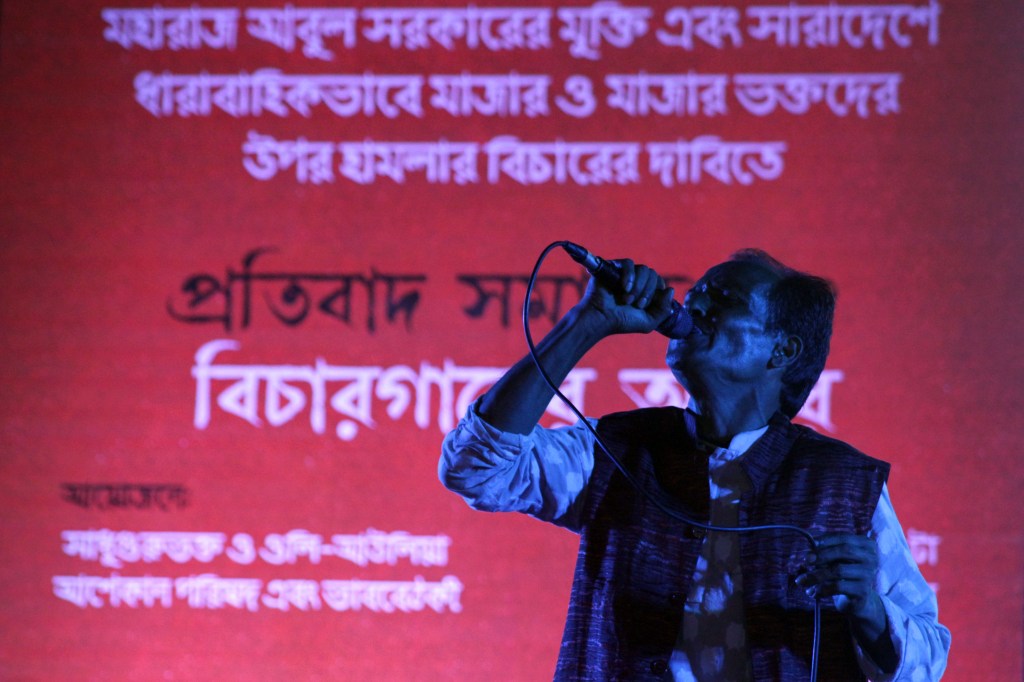
A disciple of Abul Sarkar performs during a musical protest and ‘Bichchar Gaan’ session at Dhaka’s Central Shaheed Minar, demanding the release of the imprisoned Baul leader. November 28, 2025.
📷 Sharif Khiam Ahmed/One-man Newsroom
Sharif Khiam Ahmed, Dhaka
Abul Sarkar, the leader of the country’s Baul practitioners and head of their national association, a leading figure in the country’s ancient tradition of musical spirituality, is set to spend this Eid in prison. Has a leader of the Baul devotees ever faced such a fate before, or is the country witnessing a stark new precedent?
That is the question facing Bangladesh today following the incarceration of a folk singer known within the Baul community as ‘Maharaj.’ Sarkar was arrested last November on allegations of making “derogatory remarks about Islam and Allah” at a performance in Manikganj, a district neighboring Dhaka.
Four months have passed, and his family has found no path toward his release. In a phone interview with One-man Newsroom on Tuesday afternoon (March 17), his wife, Aleya Begum, stated that the High Court rejected her husband’s bail application in the second week of this month. The family remains in the dark regarding the next hearing date in the trial court.
Speaking to One-man Newsroom on Wednesday morning (March 18), Advocate AFM Nurtaj Alam Bahar, the Public Prosecutor (PP) for the Manikganj Sessions Judge Court, confirmed that the charges against the singer are entirely bailable.
“The specific section cited in this case carries a maximum penalty of two years, a threshold where magistrates typically have the authority to grant bail,” Bahar explained. He added that the trial would be conducted in the magistrate’s court, noting that the court’s routine schedule usually spaces hearings about four to six weeks apart.
“In the Manikganj Sessions Judge Court, there have been two hearings for his bail application so far. Both times, the judge denied bail,” Bahar noted. He explained that because Sarkar spoke against Allah, the matter has become “highly sensitive,” and his remarks allegedly hurt the religious sentiments of local Muslims.
“Under these circumstances, granting him bail might lead to an ‘abnormal’ local law and order situation.” Bahar further clarified that the judge considered that Sarkar might face physical assault from an angry mob if released.
The PP also recalled instances of attacks on Sarkar’s followers within and around the Manikganj court premises. “The court’s refusal was a preventive measure based on the volatility of the current situation, despite the case meeting the technical criteria for bail,” Bahar continued.
He said Sarkar’s legal team had applied to the High Court after the District Sessions Court denied two previous applications. If the High Court also refuses bail, he added, the defense can again apply to the relevant lower courts. “So far they haven’t,” he said.
Aleya Begum expressed deep frustration. “We are seeing no end to this. No one can provide a ‘confirmation’ or certainty on when he will be released,” she said.
She believes their persecution stems from their role as promoters of Sufi saints and shrines. At a rally in front of the National Press Club on November 24, Aleya said, “For me, it’s simple: the people who are destroying the shrines, we are their rivals. They destroy shrines, and we celebrate the saints. We sing the saints’ praises. That is why they have turned against us.”
Aleya portrayed her husband as a “simple-hearted soul” with a deep sense of humanity. “I have judged him with my own Baul heart and found nothing but goodness,” she remarked.
She pointed out the irony of his detention, noting that while his works include hundreds of hymns honoring Allah, he remains behind bars. “He became a target simply because we advocate for the shrines and celebrate the legacy of the Sufi saints,” she added.
Sarkar was a prominent voice against the persecution of folk practitioners under the interim government led by Professor Muhammad Yunus. Aleya Begum told One-man Newsroom that her husband was always the first to protest against the destruction of shrines or the harassment of dervishes.
She said Sarkar was often the first to call attention to such acts. “He was a tireless advocate, heading out at dawn to document the unfolding violence,” Aleya recalled. She described how he meticulously exposed the destruction of shrines, the assault on devotees, and the looting of homes to ensure the world could not look away.
“There has long been a group (anti-Mazar Islamists) opposed to shrines. They feel that if they can weaken the head, my husband, they will succeed,” she said. “The strategy is clear,” she added, “by breaking the prominent leader at the top, they aim to strike fear into the hearts of everyone else.”
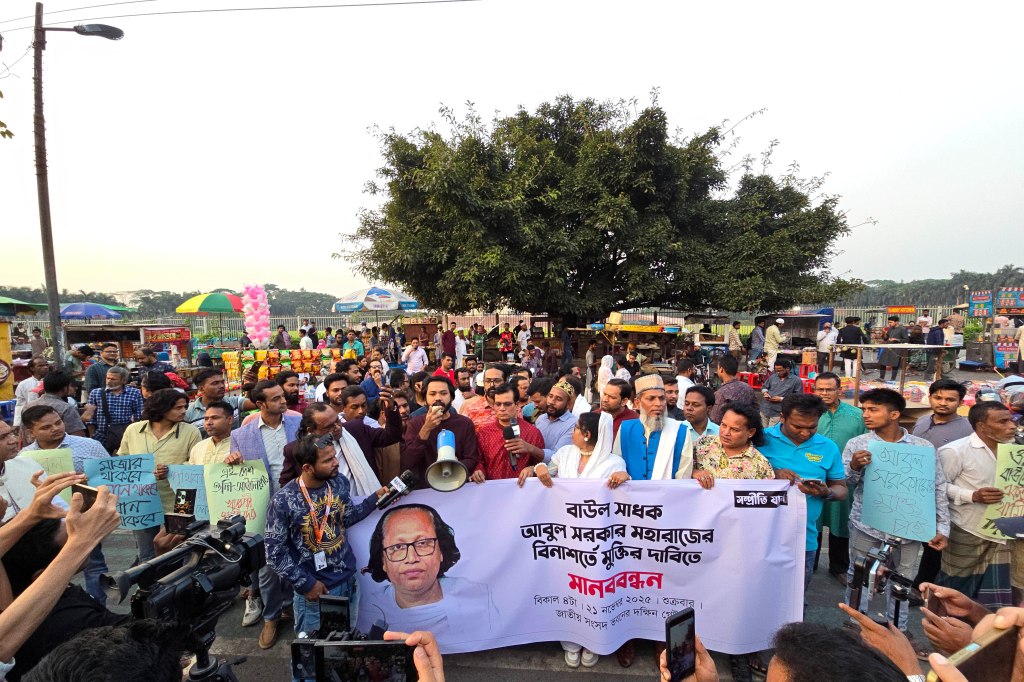
Baul artists and cultural activists gather in front of the National Parliament House on November 21, 2025. The demonstration on Manik Mia Avenue called for the immediate release of detained Baul leaders and an end to the rising repression against folk traditions in post-uprising Bangladesh.
📷 Sharif Khiam Ahmed/One-man Newsroom
Gonshai Pahlavi, a writer, artist, and sculptor who participated in a human chain and protest march in front of the National Parliament on November 21 to demand the release of Abul Sarkar, also told One-man Newsroom, “Since Abul Sarkar breaks this paradigm, since he questions, and since he himself is a bearer of a specific school of thought, they have essentially issued a threat here.”
“As he is the president of an organization, they believe that if they can capture the ‘head,’ the followers will be intimidated. They are trying to force this country into a single narrative,” he added.
“The movement that took place before August 5, 2024 (the fall of Hasina), was also a cultural movement. We, through our cultural processes, stood firmly against these (student) killings.” Gonshai continued, “And what happened after August 5? We saw the destruction of shrines and the ransacking of the ashrams of peers, fakirs, and dervishes. What does this mean?”
He mentioned, “They are destroying these because they do not like the existence of different thoughts, different schools, and the process of diverse thinking. They want a single narrative to prevail in the country. They want only one version of religion.”
“Since Abul Sarkar breaks this paradigm, since he questions, and since he himself is a bearer of a specific school of thought, they have essentially issued a threat here. As he is the president of an organization, they believe that if they can capture the ‘head,’ the followers will be intimidated. They are trying to force this country into a single narrative,” Gonshai Pahlavi added.
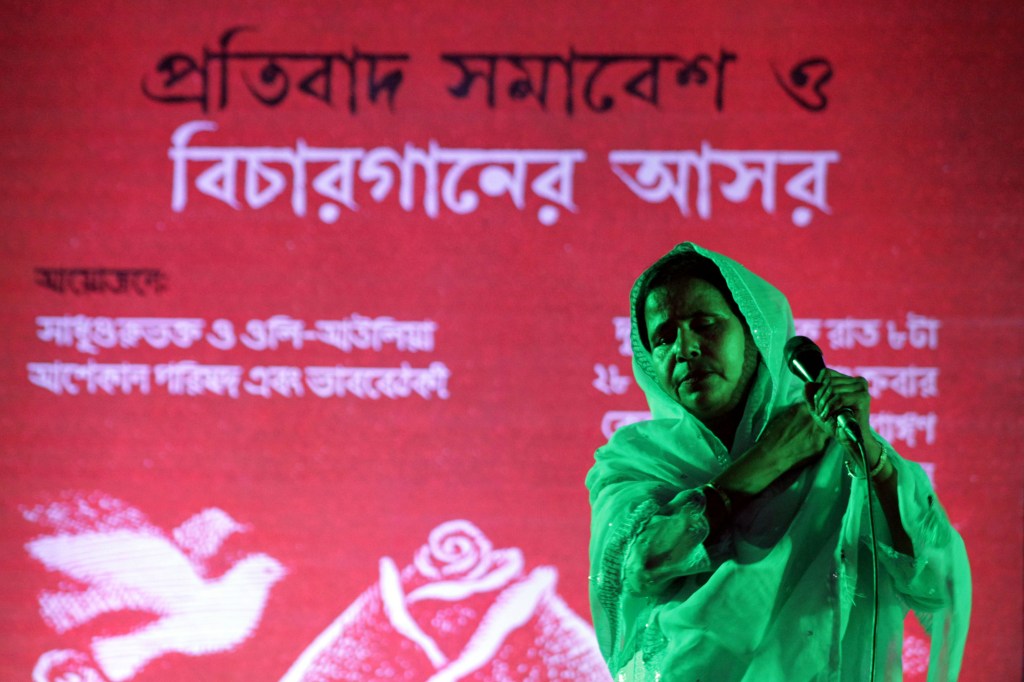
On the morning of Eid, as the country slows into its rituals of new clothes, shared meals, and quiet prayers, Aleya Begum will take a different road. She will travel to a prison. This scene follows a momentum of protest, such as the one captured at Central Shaheed Minar on November 28, 2025, in a musical ‘Bichchar Gaan’ session held to demand the release of the imprisoned Baul leader.
📷 Sharif Khiam Ahmed/One-man Newsroom
Songs under siege
Aleya Begum, also known as Alo, is a respected Baul figure in her own right, renowned as ‘Baul Mata’ (Mother of Bauls), famous for Bichched (songs of separation), Palagaan (narrative musical duels), and Jarigan (dirge or elegiac folk songs), and has written over a thousand songs in the last five decades.
Today, she is on the streets, struggling for her husband’s freedom. This struggle has brought new dangers; her protest has led to the severance of all income sources. Consequently, not only Abul Sarkar and Aleya Begum but also the families of their co-artists are facing a dire Eid.
“I was performing consistently until his arrest, but now the stage has gone silent,” she shared. Aleya revealed that extremists are actively intimidating organizers, issuing grim warnings to skip her from their lineups. “They tell the organizers that if I am allowed to perform, they will tear down the entire pandal (pavilion),” she added.
“When you lose income, people drift away. But I have 10 to 12 young musicians who depend on me. They work to feed their families. Now I sit idle. I have no income, nor do they,” Aleya said.
For her, the consequences unfold in quieter ways. Work has stopped. Invitations have dried up. Musicians who once traveled with her now sit idle. She noted that their dedicated musicians, who decline to play for anyone else, are now facing absolute destitution.
In a display of communal resilience, she is currently providing for fans and fellow performers who were victims of mob violence. “A few of them are seriously ill and unable to work,” Aleya remarked. “Since they came for us, I have to provide for their medical expenses and families.”
And yet, she continues to speak at protests, at gatherings, and in interviews, linking her husband’s arrest to a broader pattern she believes is reshaping the country’s cultural landscape.
Aleya questioned the judicial process, noting that even a death row convict is allowed to answer questions. “He has been suffering for four months in a baseless case. No court gave him a chance to speak or even looked at his condition.”
As Eid approaches, the distance between the two worlds becomes stark. Inside the prison, Abul Sarkar waits, one figure among many in a system that moves slowly, often without explanation. Outside, his community adjusts to his absence.
Aleya said she would visit Abul Sarker in prison on Eid. “On that day, he used to meet all his fans. Relatives would come. The madmen, the dervishes, and the fakirs loved him. He loves them too. He would go to Mirpur Mazar and celebrate Eid with them.”
She added, “We are people of the road; our lives are with our people. We are not household people. We are street people. Life without our people is nothing.” But there will be no gathering of singers this year. No shared circle of voices.
No open-ended conversations that stretch late into the night. Only fragments remain of songs, of memory, of a way of being that now feels, to many, uncertain.
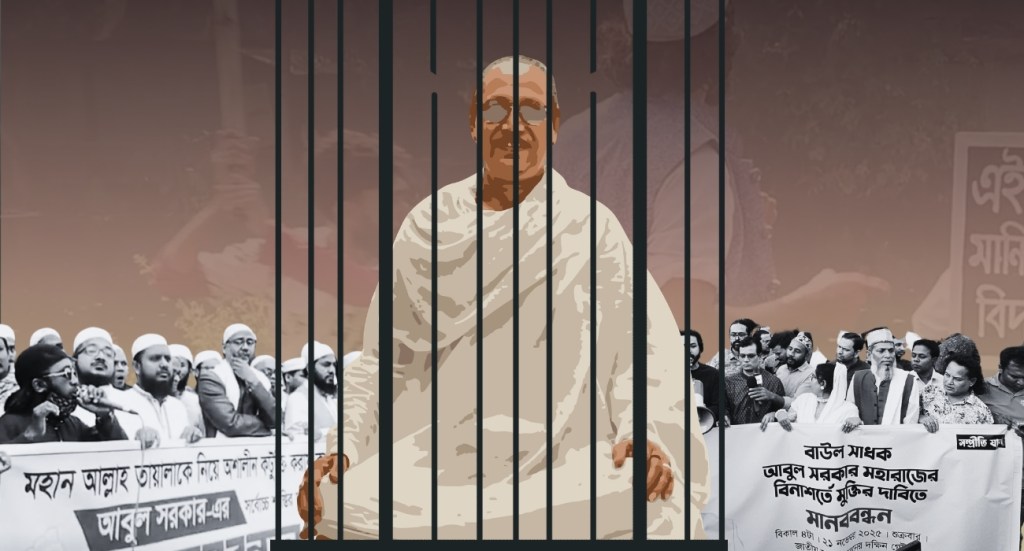
📷 One-man Newsroom Collage
From outrage to mobilization
Following Sarkar’s arrest, Manikganj saw rallies demanding his execution and threatening to “slaughter” Bauls and destroy their shrines (akhras). On November 23, the situation escalated further when a violent mob targeted and assaulted three of Sarkar’s devoted followers.
German broadcaster Deutsche Welle and other outlets documented that on November 20, the day Sarkar was in court, demonstrators under the banner of “Alem-Olama and Touhidi Jannata” held a protest outside the chief judicial magistrate’s court in Manikganj. Among the speakers was Maulana Abdul Firoz, local head of Bangladesh Khelafat Majlis.
On November 23, a second protest took place demanding punishment; on the same day, Sarkar’s supporters organized their own demonstration calling for his release. Footage obtained by One-man Newsroom captured marchers calling not only for his execution but also for the slaughter of all Bauls and the destruction of their akhras (spiritual centers).
That day, clashes outside the court left at least three of Sarkar’s supporters injured: Abdul Alim (25), Ariful Islam (29), and Zahirul Islam (32), according to local reports. One account said a madrasa teacher named Maulana Abdul Alim was seriously hurt; the police dismissed that specific version, saying he had tripped and fallen.
A baul who spoke on the record after the violence described the fear within the community. Many Bauls, fakirs, and followers are rural, impoverished, and vulnerable. That wave of mobilizations and clashes between groups alarmed rights defenders.
According to Shujon Sarkar, a disciple of the imprisoned singer, the Detective Branch (DB) of the Manikganj District Police detained Abul Sarkar during a musical performance in Madaripur on the night of November 19.
“The DB unit acted in coordination with the Rajoir Police Station to pick him up,” Shujon Sarkar told One-man Newsroom. The following afternoon, a formal complaint was lodged at the Ghior Police Station in Manikganj, charging the singer with making “derogatory remarks about Islam and Allah.”
The case, filed by Mufti Md. Abdullah, Imam of the Ghior Bazar Mosque, and four other individuals, invokes Sections 153, 295-A, and 298 of the Penal Code. Following his production in court, the chief judicial magistrate ordered his detention in jail.
Confirming the sequence of events, Manikganj Superintendent of Police Mossammat Yasmin Khatun stated that the accused was initially at the DB office before being officially recorded as arrested in the Ghior case.
During the hearing, anti-Baul groups protested at the court, demanding the maximum penalty. Video footage showed protesters alleging that Sarkar had been confusing people by misinterpreting Quranic verses while identifying as a ‘Peer.’
Those protesters under banners for “Alem-Olama and Towhidi Jannata” were demanding the maximum punishment. One spokesman said Sarkar had claimed he could not find Allah’s “backside” or head, a remark that, when clipped and circulated, sparked outrage.
The performance and the controversy
The controversy stems from a performance on November 4 in Ghior, Manikganj, during the ‘Khala Paglir Fair’ (a folk festival). The performance was a palagaan titled “Jib o Porom” (The Being and the Supreme), where Maharaj Abul Sarkar played the role of ‘Jib’ (the human) and Fakir Abul Sarkar played ‘Param’ (the Supreme Being).
A pala is a conversational folk song in which one or more bayati (lead singers) and supporting singers act out a narrative; performers often take on roles and address philosophical questions about the human and the divine. In this philosophical exchange, the character of the human asks the Supreme Being provocative questions to highlight human ignorance.
Sarkar’s co-artists claim he was illustrating the limitations of human thought. However, a specific clip where Sarkar reportedly asked, “I cannot find Allah’s backside or head,” a rhetorical provocation his fellow artists say was meant to expose human ignorance before God, not to insult faith, was circulated on social media to incite tension.
Those remarks, his supporters argue, reflect a long-standing tradition in Baul performance, a mode of devotional questioning that employs irony and absurdity to explore theological truths. Still, the isolated clip reframed them as sacrilegious.
Before his arrest, Sarkar seemed to anticipate trouble. Sarkar’s colleagues say he recognized that controversy might follow the performance. In a video from that night, he mentioned Rita Dewan, a fellow singer who faced eight cases in 2019 for a similar performance.
“Cases might be filed against me too,” Sarkar had said, “but I say this: there is no Quranic evidence against music.” Later, renowned intellectual Farhad Mazhar defended Sarkar, stating, “He did nothing wrong. Those who accused him have weak cultural knowledge”.
He alleged that this group seeks to erase the symbols of Islam and is damaging Bangladesh’s reputation internationally. Mazhar added that within Sarkar’s dramatic performances lies a traditional method of explaining religious philosophy.
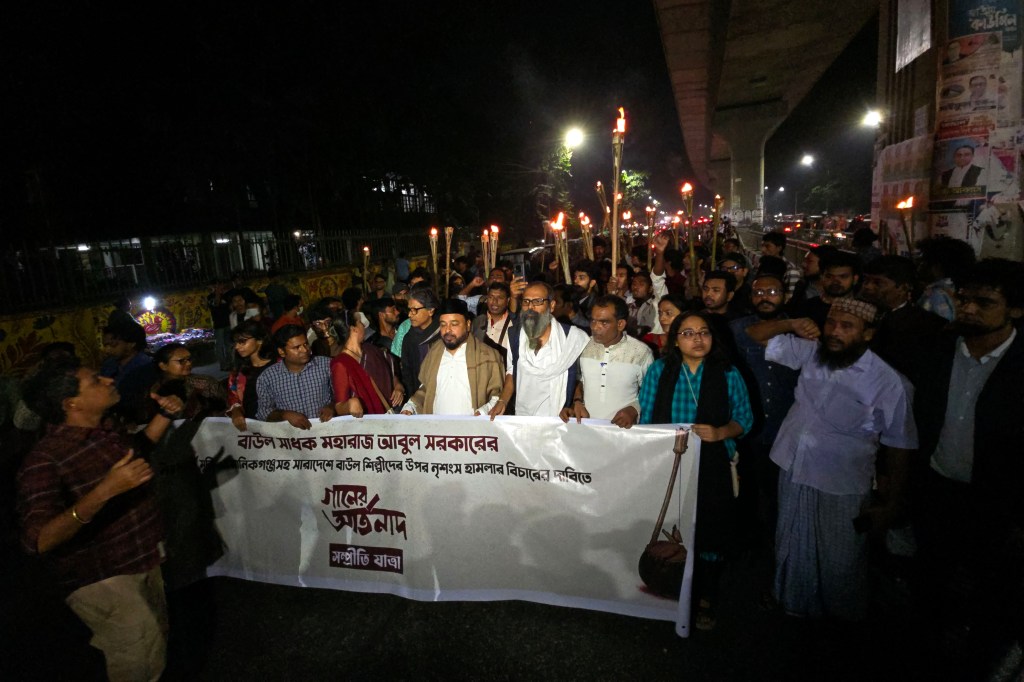
Cultural activists and students are marching through the University of Dhaka campus to protest the increasing repression against Baul traditions and folk artists. November 28, 2025.
📷 Sharif Khiam Ahmed/One-man Newsroom
The battle over spiritual expression
Earlier, in October, at the shrine of Hazrat Shah Ali Bogdadi (RA) in Mirpur, Dhaka, Abul Sarkar was among those who joined a protest against the decision of the shrine’s management committee, which affected a century-old banyan tree and the traditional environment of the shrine, and also against the ongoing repression of practitioners, fakirs, mad mystics, and Bauls across the country.
At that protest, this reporter saw Abul Sarkar deliver strong remarks against those opposing shrines. He mentioned that no one will get immunity, whether it is the local management or the District Commissioner (DC). “Today they cut trees; tomorrow they’ll demolish shrines,” Sarkar said. He accused shrine authorities of increasingly restricting traditional devotional practices.
Claiming that the relationship between Bengali mystics and trees is deeply rooted, he said that earlier, the current shrine committee had banned lighting candles and incense at the base of the banyan tree adjacent to the tomb, known as the ‘sinni tree.’
According to local belief, the tree originated from the staff used by Hazrat Shah Ali Bogdadi (RA). Many devotees used to light candles and incense under that tree to make vows. Although the shrine authorities have arranged an alternative by placing a large tray beside the tree for lighting candles and incense, devotees see this as an attack on a spiritual practice that has existed for centuries.
Sarker alleged the shrine’s mosque imams were complicit in curbs on ritual practice, noting that some imams “preach against lighting candles and vows” while still drawing salaries from shrine funds. “They are biting the very hand that feeds them. They preach against lighting candles, against vows, yet they draw their salaries from the shrine’s fund. Remove all individuals who oppose the shrine,” he mentioned.
Sarker said, “Those who do not support the shrine are not permitted to remain on the premises. Only those who stand with the shrine should manage it.”
A systematic attack on tradition
These are not isolated incidents. Analysts suggest that the conflict reflects a deeper struggle over religious authority and cultural identity. Some groups, they argue, are seeking to impose a more rigid interpretation of Islam, leaving little room for syncretic traditions like Baulism.
Mahathero Muhammad, a writer, journalist, and activist, told One-man Newsroom on January 10, “If we observe closely, we will see that in Bangladesh, attacks based on religious sentiments, killing people over slanders or false allegations, looting homes, murders, and communal attacks, these things triggered by religious sentiments are not carried out by the Tariqat-based or Sunni Muslims of Bangladesh.”
“More importantly, this entire assault, this mob, is a well-organized political force, and it has always been so. The objective of this organized political movement is to enforce a Wahhabi doctrine, seeking to dominate the social and cultural fabric of the region,” he added.
Mahathero continued, “For instance, imposing rules on how women should dress, prohibiting the lighting of candles at shrines, or banning Milad (celebrations of the prophet’s birth). This Wahhabi social control, which prevents devotees from expressing their spiritual love at shrines, is orchestrated by an organized political-cultural beneficiary group in Bangladesh.”
“This coordinated network does not operate in isolation; it maintains deep-rooted affiliations with various political parties and academic institutions across the country,” he added.
On the evening of January 10, standing near the historic High Court Mazar, the final resting place of the ‘Oli-e-Bangla,’ Hazrat Shah Khaja Sharfuddin Chisti (Rh.), One-man Newsroom spoke with Mahathero Muhammad.
Our dialogue highlighted a stark and burgeoning crisis, marked by the first-time disruption of the traditional Urs and reports of physical assaults on followers within the walls of a centuries-old spiritual landmark.
“For example, we saw that after August 5, 2024, Mamunul Haque (a leader of Bangladesh Khelafat Majlis and Hefazat-e-Islam Bangladesh) called for the destruction of all shrines, all darbars, and all khankahs. We also know that the body of Nural Pagol was exhumed and burnt. In various areas, forces supported by the ‘DUCSU-winning July Champions’ attacked the mystics (pagols). There is a well-organized political and cultural group behind this,” Mahathero Muhammad said.
According to this activist, these groups have been creating such situations in various ways over time. “What we have been calling a ‘mob’—a mob reacting to insults against religious sentiments, or the logic often provided by the police that they must keep Baul Abul Sarkar in jail because they cannot ensure his safety outside, is not actually a mob in its true sense,” he said.
Mahathero Muhammad contends that a specific political faction is exploiting the power vacuum in post-uprising Bangladesh to orchestrate a strategic political showdown. He added, “You cannot engage with them in theological debates. They will not enter into the deep complexities of religious scriptures and do not feel the need to.”
Mahathero continued, “What they have is this: in Bangladesh, whenever they call, students from Qawmi madrasas empty the institutions to join them. Jamat-e-Islami has immense political power. Then there is the Manhaji group of Ahl-e-Hadith, which also holds a significant position of power. They want to impose their Akidah (creed) and ideology upon all other people in Bangladesh.”
“They are well-organized; everyone has their own political party. The leaders of these parties, like Mamunul Haque, whom I mentioned, openly announced these destructions after August 5, 2024. Mufti Harun Izhar (another leader of Hefazat-e-Islam Bangladesh) also has a hand in this,” he claimed.
“My point is, let Mufti Harun Izhar, Mamunul Haque, or Jamat-e-Islami practice according to their beliefs, the followers of Sharfuddin never had any objection to this in the history of this country. If the followers of Sharfuddin had obstructed them at the beginning of their preaching, if what they are doing today had been done to them back then, their ideology would never have spread,” he concluded.
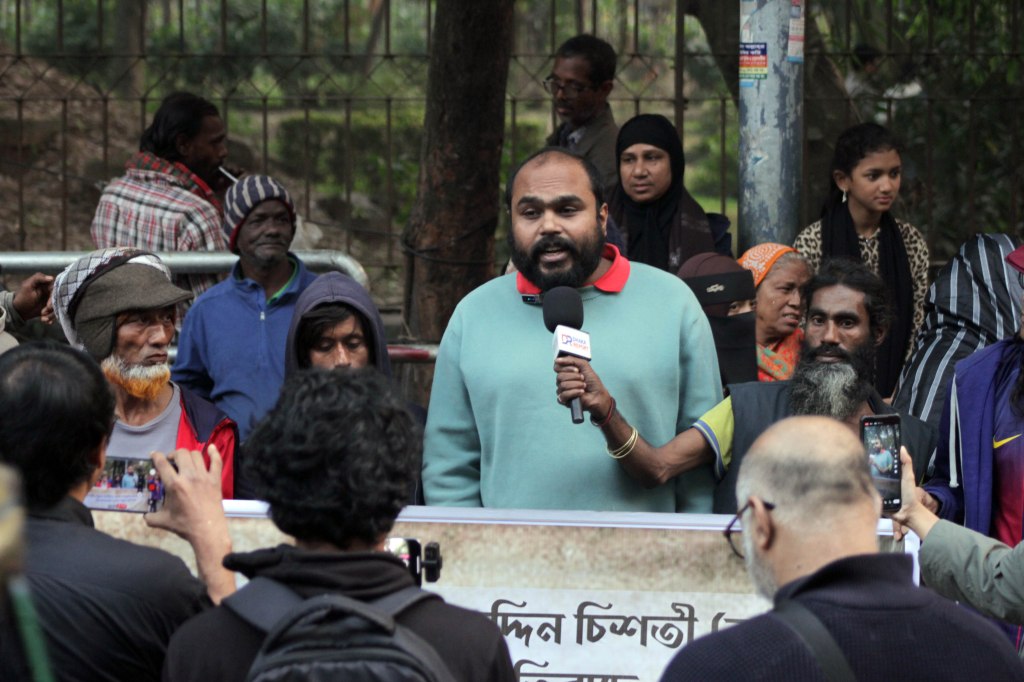
Members of a civil society group form a human chain in front of the shrine of Shah Khwaja Sharfuddin Chishti in Dhaka to protest the reported obstruction of the annual Urs. Participants demanded respect for centuries-old traditions and voiced concern over restrictions on devotees’ access to the revered site. January 10, 2026.
📷 Sharif Khiam Ahmed/One-man Newsroom
The interim under scrutiny
The arrest of Abul Sarker intensified allegations that the interim government was indulging “far-right Muslim extremists.” Government advisers have also expressed concern about the situation.
“After joining the government, the last four days have been the most uncomfortable for me. Many have asked me why I am remaining silent. I have said our job is to do the work, not to issue statements while sitting in government,” wrote the government’s cultural adviser, Mostofa Sarwar Farooki, in a Facebook post on November 24.
“But now I feel that for the record, I should speak on a few issues,” Farooki wrote, adding, “The moment I learned that the police had taken Abul Sarkar into custody, I contacted the Home Ministry to address the matter. Upon my inquiry, they provided a video clip while briefing me on the volatility and inherent risks of the situation. It became immediately apparent that the entire matter was escalating toward a full-blown crisis.”
“In taking action on any criminal offense, the primary role lies with the Ministry of Home Affairs. From my side, I am doing and saying whatever I can. Beyond this, it is not appropriate for me to write more here for certain reasons,” added the filmmaker and advertising director when in power.
The previous day (November 23), the government’s information adviser, Mahfuz Alam, also wrote in a Facebook post, “The oppressed are becoming oppressors; the anti-fascists are becoming fascists. The entire situation is one of frustration and anger.”
Mahfuz, known as the “mastermind” of the movement that toppled the previous Awami League government, said, “Those who, instead of replacing oppression with justice and violence with compassion, are creating new levels of oppression and violence will be responsible for the resurgence of fascism. The suppression of diverse thoughts and practices within society and the state creates a fertile ground for the resurgence of fascism, ultimately leading to the failure of the July uprising.”
“Let all forms of oppression against Sufi practitioners, fakirs, Bauls, and all dissenters stop,” added the widely discussed adviser, who now leads ‘Alternatives,’ a political platform striving to establish a new democratic and inclusive governance model in Bangladesh.
On the same day (November 23), in a joint statement, 258 distinguished citizens—including university teachers, Supreme Court lawyers, writers, artists, and journalists—said, “With deep concern, we observe that after the July mass uprising, religious extremism has been rising. A particular group seems to have emerged as the ‘sole agent’ of Islam and launched a purification campaign across the country.”
The statement said, “Breaking more than two hundred shrines; declaring numerous individuals apostates, infidels, and blasphemers; exhuming bodies from graves and burning them; forcibly cutting the hair of Baul-fakirs on the streets; harassing women over their movement and dress; and disrupting events such as music, theater, even sports and fairs—through all these, it appears they aim to eliminate people of different beliefs and practices.”
“The core spirit of the July uprising was to build an inclusive democratic state—an intention also expressed in the interim government’s commitments,” the signatories noted.
“But in reality, those responsible for maintaining law and order have not taken any effective role in stopping mob violence or vigilantism; rather, from the beginning, through silence, they have encouraged it, even attempting to downplay incidents by calling them ‘pressure groups’ and detaining victims or those attacked in false cases. The most recent example of this is Baul Abul Sarkar Maharaj.”
“Nearly eighteen months since the July uprising, the government appears to be patronizing religious fascism as a tactical maneuver to solidify its hold on power. Such a situation is alienating democratic-minded people from the new arrangement and, at the same time, facilitating the return of defeated fascist forces,” they added.
At a November 24 rally, Farhad Mazhar also alleged that although the interim government had promised to ensure personal freedom after the July uprising, it had not. He claimed that a looting and mafia network is trying to control the administration ahead of elections and is carrying out attacks on shrines and repression against Bauls with arrogance.

Why Are Devotees Protesting the Pruning of a Banyan at Shah Ali?
Activists say shrines face a systematic crackdown in Bangladesh.
Interestingly, Sarkar had sought votes for the BNP candidate, Afroza Khanom Rita, during the very performance that led to his arrest. He argued that if groups that destroy shrines come to power, they will eventually target the homes of the practitioners. In the 13th General Election, Afroza Khanam Rita secured her victory with the highest margin among the seven elected female lawmakers.
Rita garnered 167,345 votes. Her nearest rival, Muhammad Said Nur of the 11-party alliance-backed Bangladesh Khelafat Majlish, received 64,242 votes, leaving a staggering margin of 103,103 votes. She led in 148 out of 151 polling centers, becoming the first female Member of Parliament from this constituency since independence. Following the election, she became a minister in the cabinet led by Tarique Rahman.
When asked if she had met with the newly appointed minister, Aleya Begum said, “The party has just come to power, and she has only recently become a minister; they have a lot of organizing to do. I haven’t wanted to overwhelm them with my concerns. I haven’t reached out because they are preoccupied with national matters.”
“For instance, Rita Apa is focused on the welfare of Manikganj, addressing its shortages and needs. If I go and add extra pressure now, I feel it might only add to her burden, as I know in her heart she truly wants him (Abul Sarkar) to be released.”
“In the High Court, those who oppose us, those who detained him and filed the allegations, raised strong objections. They argued that he must not be granted bail under any circumstances. If the law takes such a turn, we have nothing left to say. We are helpless here,” she told One-man Newsroom.
How Corporate Capital is Shaping a Regional Crisis
Adani, Cricket, and the India–Bangladesh Power Play.
How Bangladesh Became a Campaign Issue in India
Hasina’s fall and the BJP’s Bengal calculus.
Why Hasina’s fall is a Strategic Shock for India
The way Delhi lost its ‘only trusted neighbor.’
 One-man Newsroom
Leave a comment