
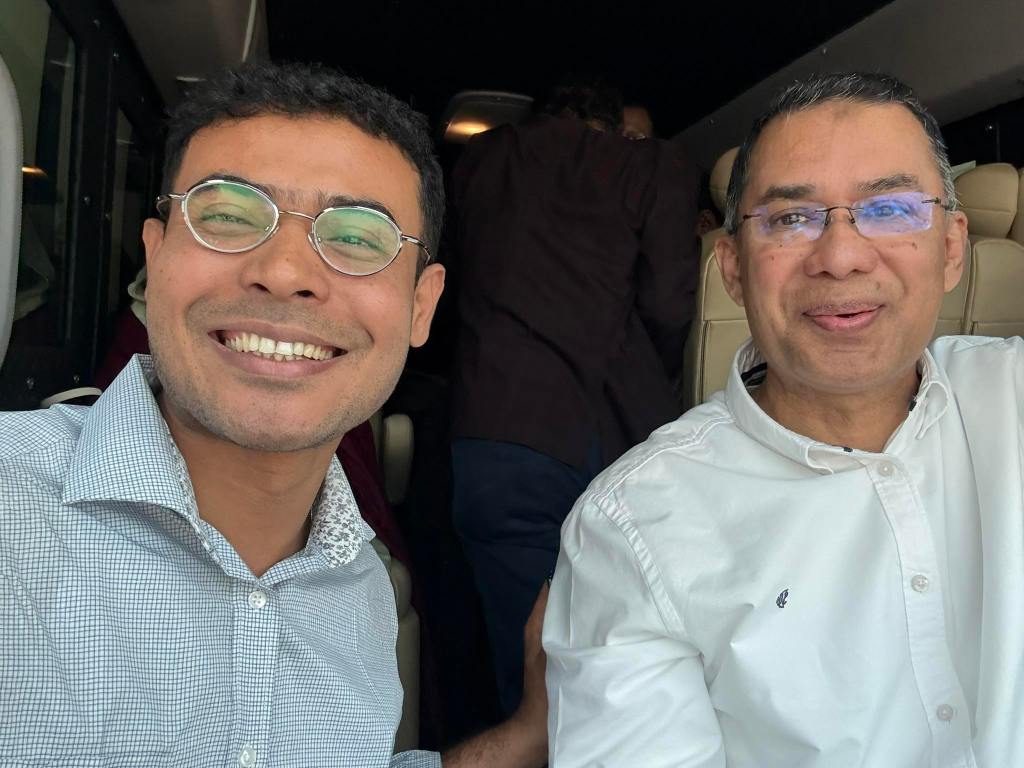
In the shifting political landscape of Bangladesh, even a direct line to the top offers no immunity.
While covering the February elections, independent journalist Tanbirul Miraj Ripon captured a moment with BNP chief Tarique Rahman during an interview for The Economist. He later shared this selfie on social media on January 27, documenting a key point in his campaign coverage.
Yet, in a stark irony, just six weeks after Rahman assumed the mantle of state leadership, Ripon found himself in a cold interrogation room, being ‘warned’ by the country’s elite military intelligence.
The Directorate General of Forces Intelligence (DGFI) did not summon Ripon because of the selfie, but rather for his professional meeting with a foreign national. However, the incident highlights a chilling reality: despite his high-profile access to the Head of State, Ripon remains a target of the state’s security apparatus.
On Wednesday (April 1), Ripon told One-man Newsroom that the encounter was so unsettling that he has officially notified the Prime Minister’s Office, fearing for the safety of his family.
‘Advice’ or intimidation?
The interrogation took place on March 30, when a DGFI official (with the rank of Major) summoned Ripon regarding his contact with a foreigner. According to Ripon, the discussion quickly veered away from professional activities and into the intimate details of his private life.
The official reportedly grilled him on his family’s whereabouts and the security of his ancestral home, sending a clear message: the journalist is under constant surveillance.
In a move seen as a curb on journalistic freedom, the official demanded that Ripon report all future meetings with foreigners to their office.
Refusing to be silenced
Breaking his silence on Facebook on Thursday (April 2), Ripon wrote, “For six years, I have covered human rights and the refugee crisis for international media. Recently, I was kept in a conference room for twenty minutes before a Major began questioning me without any clear cause. The ‘advice’ given to me about my work was vague, but the tone was unmistakably a threat.”
“I was also summoned by previous administrations, too, but it is deeply disappointing to see this ‘culture of fear’ persist when we are striving for a democratic and humane state. I have fought for press freedom before, and I will not stop now,” he added.
The world is watching
The incident first came to light through Bangladesh Media Monitor, which independently verified that Ripon, a contributor to The Economist, Sky News, and The New Humanitarian, was summoned to the DGFI office in Cox’s Bazar on March 30.
The watchdog reported that a Major-rank officer interrogated him about his professional role and family background, ultimately warning him to report to the office regularly.
Expressing grave concern, Kunal Majumder, CPJ’s Asia Pacific Program Coordinator, stated, “Bangladeshi authorities must immediately end the harassment of independent journalist Tanbirul Miraj Ripon and stop deploying the military to question members of the press.”
“Journalists should not be summoned by intelligence agencies or questioned about their private lives simply for doing their jobs. These actions undermine press freedom,” Kunal added.
While German broadcaster DW (Deutsche Welle) has since covered the development, the Inter-Services Public Relations (ISPR) has remained silent on the allegations.
The Journalist the Generals Couldn’t Silence
From torture and exile to exposing Bangladesh’s military deep state.
Dhaka and Beijing Advocate the AA’s Role in Rakhine Peace
The rebels became crucial for the Rohingya’s repatriation.
 One-man Newsroom
Leave a comment