
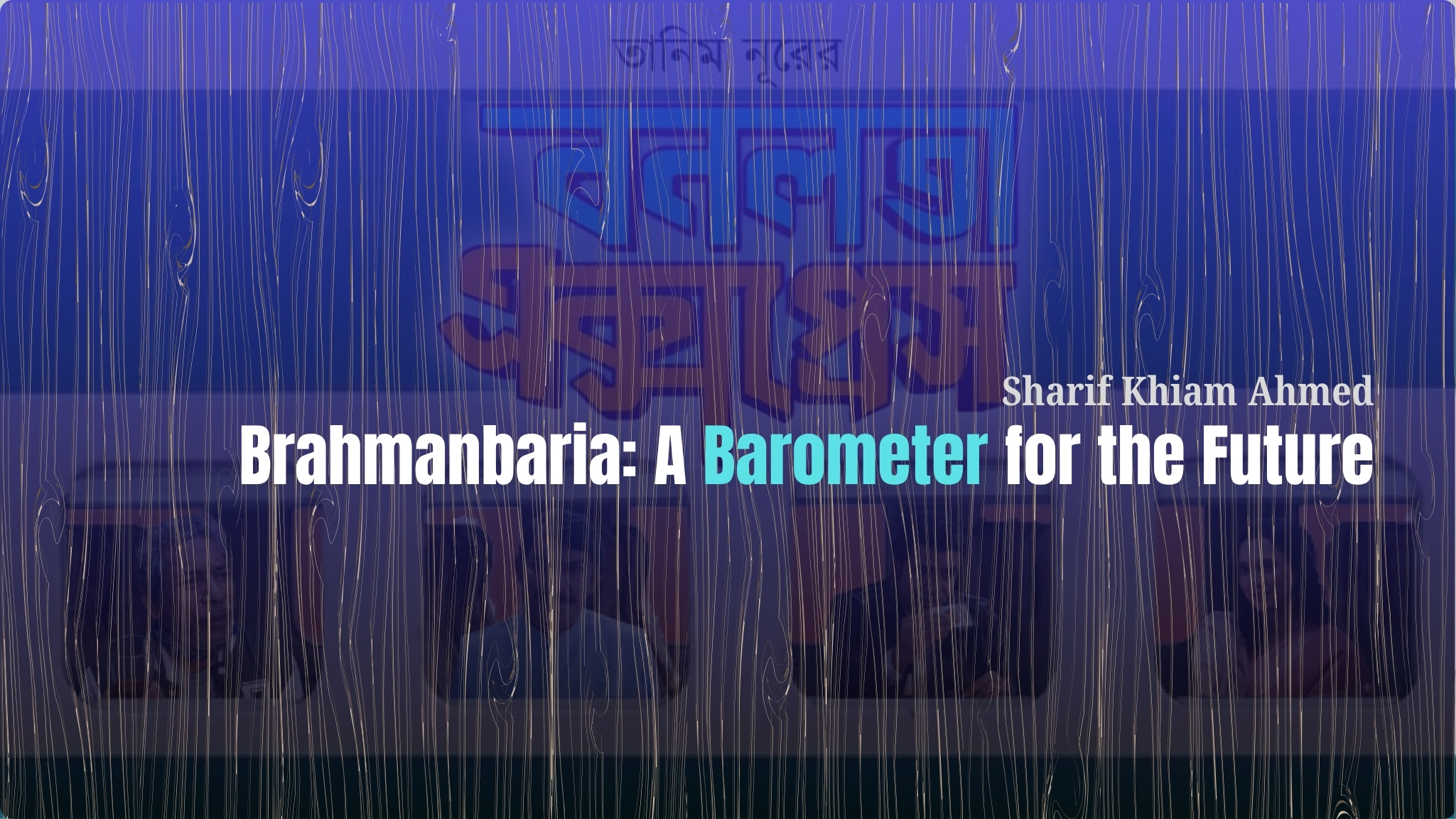
This commentary addresses a significant concern for Bangladesh’s cultural heartlands: will they yield to intimidation, or will they foster environments that promote art, memory, and dissent? This dilemma mirrors a larger trend of suppressing public culture throughout the nation. It’s a wake-up call: cultural centers can no longer assume their safety is guaranteed. In a region renowned for its music and literature, the struggle to host a film screening suggests the issue lies not with the film itself but with the oppressive climate surrounding it.
Brahmanbaria, a Bangladeshi district bordering the Indian state of Tripura, had at least 15 to 20 cinema halls in the 1990s. Among them, the most well-known were Rupali, Rajanigandha, Chitrali, and Abakash in the district town. Across the upazilas, there were halls such as Basundhara, Anuradha, Anurag, Mayabe, Meghna, Kohinoor, Lucky, Nabin, Nupur, Shilpi Milon, Titas, Palash, and Binodon.
A report titled “Cinema Halls of Brahmanbaria in Existential Crisis,” published on Jago News on October 24, 2015, stated that at least six cinema halls in the district were still operational at that time. However, four years later, on November 1, 2019, Prothom Alo referenced the Cinema Hall Owners and Exhibitors’ Association in a report titled “Half of the Cinema Halls Closed in a Single Year.” This report indicated that no cinema halls remained open in the headquarters of 15 to 20 districts, including Brahmanbaria.
On November 19, 2024, Bangladesh Pratidin reported under the headline “Famous Cinema Halls Closed” that 29 districts no longer have cinema halls. Notably, a report by the same correspondent, Alauddin Mazid, in the same newspaper on May 19 of this year had the headline “No Cinema Halls in 16 Districts.” Interestingly, Brahmanbaria remains at the top of the list of districts without any cinema halls.
These halls, which once hosted ‘house full’ shows on Fridays, attracting families and audiences, were demolished to stabilise multi-story residential and commercial buildings. Media reports indicate that since the beginning of this decade, no cinema halls have been operational in the entire Brahmanbaria district.
Interestingly, this same decade has witnessed the emergence of Tasnova Tamanna, a 2023 National Film Award-winning actress from this region, alongside the promising filmmaker, screenwriter, and producer, Tanim Noor (born Abdullah Al Noor), who is best known for his acclaimed films Utshob (2025) and Bonolota Express (2026).
The recent obstruction of his film, ‘Bonolota Express,’ by local Qawmi madrasa students and affiliated groups has once again highlighted the evolving social landscape of Brahmanbaria. He called the episode painful and said art and healthy entertainment do not harm society or belief.
In a Facebook post, Tanim Noor also argued that a certified film cannot simply be branded obscene and shut down. That argument is central to the whole controversy. In a normal public culture, it would be obvious. In Brahmanbaria, it is not. Over the past decade, the violent activities of hard-line Islamists in this area, including attacks on the settlements of minority Hindu or Ahmadiyya communities, have repeatedly made international headlines.
This district in the Chittagong Division earned the title of the ‘Cultural Capital’ of Bangladesh because of its diverse and rich heritage, making it a vital part of the nation’s identity. It would not be an exaggeration to say that people from this district have also contributed to world cinema.
The timeless masterpiece by Ritwik Ghatak, Titas Ekti Nadir Naam, was based on one of the greatest novels of Bengali literature, written by Adwaita Mallabarman of this district. The story follows the Malo fishing community (Jhalo Malo) of the Titas River, to which Adwaita belonged, uprooted in the aftermath of the Partition of India.
Brahmanbaria is the birthplace of the ‘Shur-Shamrat’ (Emperor of Melody) Ustad Allauddin Khan, the creator of the Maihar Gharana and a world-renowned musician. Later, his successors and family, Ali Akbar Khan, Amjad Ali Khan, and Annapurna Devi, have spread the name of this area across the world of music. Leading figures of the Maihar gharana, particularly Ali Akbar Khan and Amjad Ali Khan, have made significant contributions to film music by providing classical compositions and performances instead of creating traditional film songs.
Credited as composer on several films from the 1950s–1960s and later, Ali Akbar Khan’s recordings are now also in modern films such as The Darjeeling Limited (2007) and Taking Woodstock (2009). Amjad Ali Khan has composed and recorded music for films and soundtracks, collaborating on various projects too. Their recordings are licensed internationally, introducing the sound of the Maihar tradition to global cinema.
Al Mahmud, one of the foremost poets of modern Bengali literature, also hailed from Brahmanbaria. His short story Jalbeshya, drawn from the lives of fishing communities along the Meghna River in a village of Brahmanbaria, was adapted into the film Taan by director Mukul Ray Chaudhury. Beyond this adaptation, Al‑Mahmud also wrote lyrics for several Bangladeshi films, bringing his poetic sensibility into popular culture.
Portions of the acclaimed Bangladeshi films Ghetuputra Komola, directed by Humayun Ahmed (2012), and Sphulingo, directed by Tauquir Ahmed (2021), were filmed in various locations across Brahmanbaria, where the riverine landscapes and rural fishing communities provided a striking natural backdrop.
Therefore, I was not particularly surprised by what has happened or is happening regarding ‘Bonolota Express,’ one of the most commercially successful Bengali movies of recent times. Yet, it is essential to document the reasons for this lack of surprise. Because through my work with international media, I have had to cover several incidents in Brahmanbaria, the majority of which concerned the rise of extremist Islamism.
The abrupt cancellation of a public screening of the film in Brahmanbaria is far more than a routine administrative decision to revoke a venue permit. Instead, it serves as a stark window into a deeper structural crisis, illuminating the narrowing of civic spaces, the contestation over public spheres, and the escalating political leverage of religious hard-liners in contemporary Bangladesh.
What began as a modest, youth-led cultural gathering quickly escalated into a tense social and political standoff, reflecting a long-standing decline of cultural institutionalism in the region. Meaning, Brahmanbaria’s current situation stands in stark contrast to its historical legacy as a hub of art and intellect.
Earlier, I mentioned that by 2015, that number had dwindled to around six, and the collapse accelerated rapidly thereafter. By the early 2020s, Brahmanbaria had effectively become a ‘cinema hall-less’ district. It was within this institutional vacuum that the Brahmanbaria Film Society, a platform organised by local students and youth, attempted to host a screening at the Annada Government High School, part of their year-long initiative, ‘Bhattghumer Cinema Adda’, in a grassroots effort to sustain a dying film culture. Nonetheless, the strategy to prevent the screening suggests a strong assertion of regional cultural dominance.
Qawmi madrasa-based student factions and leaders associated with Hefazat-e-Islam launched an aggressive campaign across social media networks, branding the film as a source of ‘obscenity’ and ‘social discord’. Following a coordinated strategy meeting on May 29 at the Jamia Islamia Younusia Madrasa, influential figures, including the district Hefazat secretary Maulana Ali Azam Kasemi, formalised their opposition.
Hafez Nasrullah Moaz, a leader of the Qawmi Chhatra Oikya Parishad, along with other activists, circulated digital posters of the film defaced with a red cross, declaring Brahmanbaria an ‘exclusive domain of Islamic scholars’ and vowing to resist any attempt to revive cinema culture.
This rhetoric represents a calculated territorial claim, seeking to redefine a historically pluralistic urban centre not as a shared civic space but as a strictly monitored moral enclave. In the face of this organised pressure, the state apparatus and local administration adopted a defensive posture of appeasement rather than safeguarding constitutional cultural rights.
Bokhtiar Shahriar, general secretary of the Brahmanbaria Film Society, stated that while school authorities had initially granted verbal permission, they abruptly rescinded it. Conversely, Sabina Yasmin, the acting headmistress of Annada Government High School, denied the organisers’ assertions. Simultaneously, the local government distanced itself from the event; Brahmanbaria Deputy Commissioner Md Abu Sayeed said the administration was not formally aware of the matter.
“We learned about it informally through Facebook discussions,” the DC said, “Given the sensitivity of the issue, the screening of ‘Bonolota Express’ will remain suspended for now.” When the state fails to protect legitimate cultural expressions under threat from hard-line factions, the threat itself effectively becomes unwritten public policy.
Police and local administration reportedly halted another screening of the film Bonolota Express at Taltala Government Primary School in Kasba, Brahmanbaria, on the night of May 30. Adib Reza Rongon, a cartoonist and comic book artist, organized it, following the suspension of the original screening in Brahmanbaria Sadar.
Rongon alleged that a significant police presence, led by the Assistant Commissioner (Land) and the local Police Chief, arrived 15 minutes before the scheduled 11:00 PM start, citing the ongoing controversy in the district town as the reason for the intervention.
Nazneen Sultana, the Officer-in-Charge (OC) of Kasba Police Station, said the organizers decided to halt the event themselves due to their lack of authorization. Assistant Commissioner (Land) Md. Tanjil Kabir stated that the administration acted in response to a complaint indicating that the screening could potentially disrupt law and order.
According to Prothom Alo, Maulana Ali Azam Kasemi stated, “A meeting was held yesterday (May 29) with the district’s Islamic scholars and the students of the Qawmi Chhatra Oikya Parishad to discuss the matter.”
Maulana Kasemi is a prominent Islamic scholar and influential local leader. He is also active within national Islamic political frameworks, having served as a central leader or general secretary within wings of Jamiat Ulema-e-Islam Bangladesh (JUI‑B), a political ally of the ruling Bangladesh Nationalist Party (BNP). He heavily influences local administrative, cultural, and religious affairs in Brahmanbaria.
Following political transitions in Bangladesh, Maulana Ali Azam Kasemi has spearheaded multiple large-scale rallies and protest marches in Brahmanbaria. This place has long served as a strategic epicenter for both Qawmi religious scholarship and Islamist politics in Bangladesh.
“There are two main issues: firstly, the movie itself, and secondly, the comments made by a certain group on Facebook regarding ‘Allama Fakhre Bangal Tajul Islam (rah.)’. As a result, the situation has taken a different turn,” Maulana Kasemi said.
The religious landscape of the district was significantly influenced by Allama Tajul Islam, widely known as ‘Boro Hujur’ (senior scholar). He established a strong tradition of Islamic education at Jamia Islamia Yunusia Madrasa. Shaykhul Hadith Maulana Azizul Haque (rah.) played an important role in this intellectual tradition. He is the father of the well-known contemporary activist Maulana Mamunul Haque.
Although his ancestral roots trace back to Munshiganj, Maulana Azizul Haque’s influence in Brahmanbaria was profound; he taught at the Jamia Islamia Yunusia for years and was the son-in-law of Allama Tajul Islam. This familial and academic bond solidified a bridge between traditional scholarship and modern political activism, a path later traversed by Maulana Mamunul Haque through his high-profile leadership within Hefazat-e-Islam.
Brahmanbaria’s political importance has grown significantly due to Ghulam Azam, the former Amir of Jamaat-e-Islami. His ancestral home in Birgaon, Nabinagar, connects the area to crucial national discussions about Islamist political ideology and its impact on the state.
Together, these overlapping layers of clerical authority and political heritage have transformed Brahmanbaria into a significant nexus. It remains a place where the legacy of traditional scholars and the mobilization of modern Islamist movements converge, making it a critical barometer for the conservative Islamic pulse in contemporary Bangladesh.
The line between cultural objection and political mobilization becomes clearer when one looks at the broader religious ecosystem surrounding the controversy. AP reported in 2025 that Islamist groups in Bangladesh had increased their visibility after Sheikh Hasina’s ouster, and that minority communities had complained of intimidation. The same AP report described Mamunul Haque, a Hefazat leader, as one of the movement’s public faces. Prothom Alo, meanwhile, identified him as the ameer of Bangladesh Khelafat Majlis.
In other words, the Brahmanbaria controversy is occurring in a political environment where Islamist actors have moved from the margins of visibility. That wider shift also helps explain why this district now feels like a pressure point.
Reuters reported in February 2026 that Jamaat-e-Islami had re-emerged as a serious national force after the 2024 uprising that toppled Hasina, with party chief Shafiqur Rahman moving from the political margins to become a serious contender in the country’s first election after the uprising. Reuters added that, under Hasina’s leadership, Jamaat was a banned party.
However, following the lifting of this ban in 2025, the party has re-emerged on the political stage, signaling a pivotal moment in the nation’s political evolution. That is the national backdrop against which Brahmanbaria’s local cultural disputes are taking place: Islamist politics is no longer simply a residue of the past; it is part of the present political arithmetic.
Perhaps no place better illustrates the transformation of Brahmanbaria than the repeated attacks on the cultural complex dedicated to legendary musician Allauddin Khan. In 2016 and again in 2021, the Sangeet Angan came under attack and was burned, with instruments, documents, and archival material destroyed. Reports described how the academy was devastated and how, according to the account cited there, neither the police nor the fire service arrived in time to stop the damage. Local activists now warn that the institution faces additional threats from alleged land-grabbing attempts.
On April 26, 2026, The Asian Age reported a protest in Brahmanbaria against an alleged attempt to grab the land of Ustad Allauddin Khan Sangeet Angan, while Views Bangladesh reported on May 16 that cultural figures and citizens had demanded government intervention to protect the land. The report indicated that Allauddin Khan purchased the property in 1955 and donated it in 1956. The symbolism is difficult to ignore. A district that gave birth to one of South Asia’s greatest musicians has struggled to protect the institution preserving his legacy.
To understand why these matters are beyond one district, it helps to remember Bangladesh’s earlier history of anti-cultural violence. The 2001 Ramna Batamul bombing killed 10 people and wounded dozens during Pohela Boishakh celebrations, according to The Daily Star. In 2002, coordinated bombings hit four cinema halls in Mymensingh; reports at the time described 17 to 19 deaths and more than 200 injuries.
That history makes Brahmanbaria more than a local case. It is a warning about how public space gets narrowed. When a film screening is blocked, the next target may be a theater, a book fair, a music recital or a school event. When cultural life must constantly seek permission from those prepared to veto it, the social contract changes. A district that once produced classical music for the world and literature for Bengali modernity can begin to look like a place where only one kind of public expression feels safe.

What Media Startups Reveal About Bangladesh’s Intellectual Property Culture
Beyond the copycat culture: imitation vs. innovation.

Headlines vs. Realities: The Crisis of Border Journalism
The complexity of the Bangladesh-India frontier.

Why Mobs Won’t Let Sufis Rest in Their Own Shrines?
Uprooting folk Islam’s final sanctuaries in Bangladesh.

Media Pollution Is Choking India’s Democracy
Manufacturing consent in the age of ‘Hindutva.’

A New Press Wing and the Politics of Credibility
Rebuilding the state’s communication in a new era.

Post-Institutional Journalism from the Global South
2025: the year I stopped waiting for outlets.
Leave a Reply