
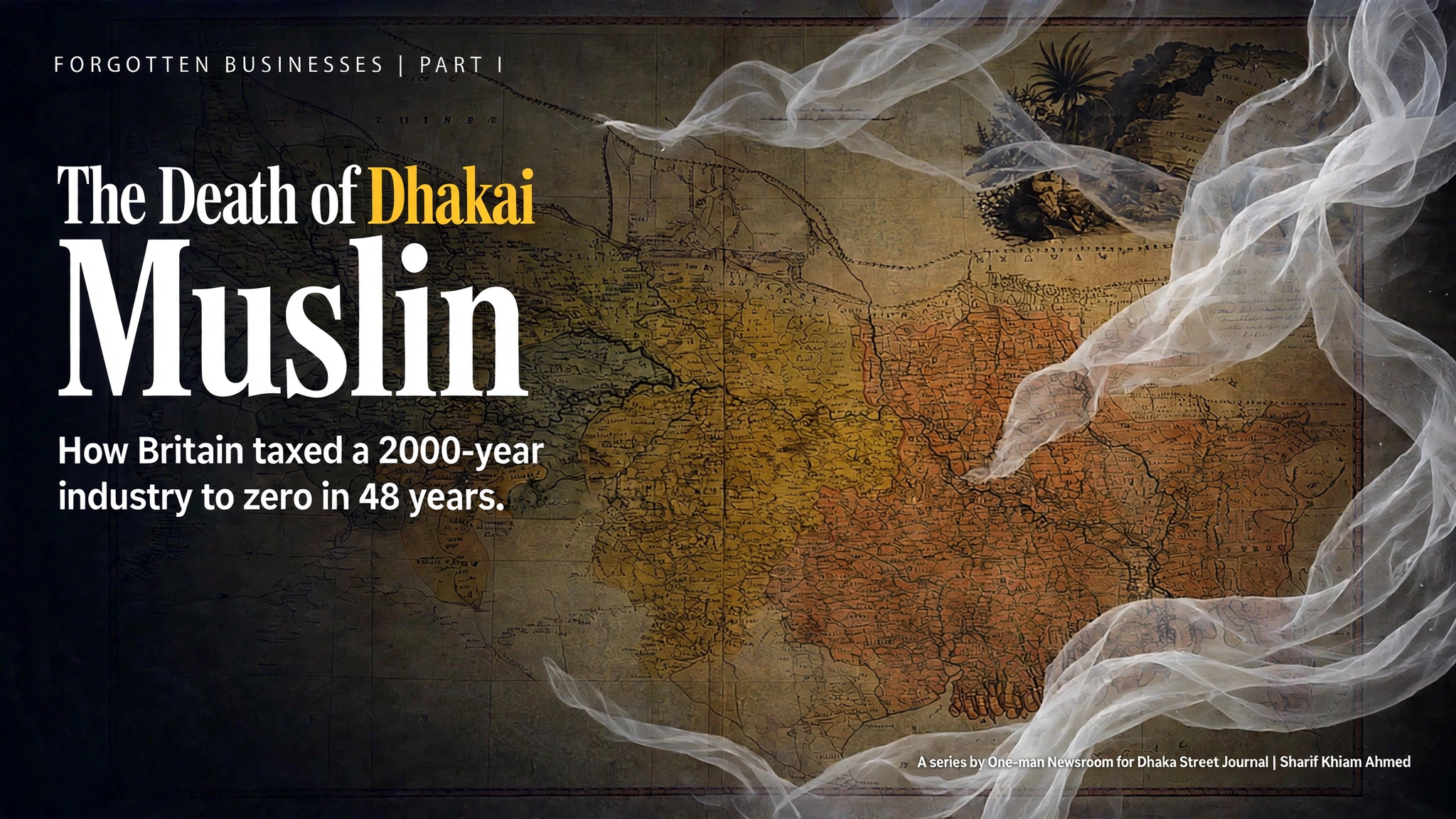
📷 AI reconstruction based on an archival image from the British Museum.
Sharif Khiam Ahmed, Dhaka
The tragic collapse of Dhakai Muslin, once the undisputed pinnacle of global luxury textiles, was neither an organic tragedy of technological evolution nor an inevitable casualty of free-market obsolescence. Rather, colonial administrative archives, testimonies, and official statistical surveys compiled by British officials represented a deliberate, policy-driven economic execution.
Under the commercial hegemony of the British East India Company and the subsequent fiscal apparatus, a lethal combination of monopsonistic procurement constraints, coercive advance-debt systems, punitive ad valorem tariffs in Great Britain, and discriminatory internal customs barriers systematically dismantled Bengal’s handloom ecosystem.
Through this institutional subversion, British administrators transformed Dhaka from a premier global manufacturing metropolis into a deindustrialized, economically depressed, and severely depopulated provincial town during the 19th century.
Before colonial territorial conquest, Dhaka was the global center of fine cotton manufacturing, supported by state-supervised imperial workshops and a vast network of hereditary artisan guilds.
In a long personal letter sent from Dhaka on August 31, 1765, to his friend Reverend Gilbert Burrington, Major James Rennell, the first Surveyor-General of India, observed that the city stretching four miles along the Buriganga River still retained some trade, but was a mere fraction of the immense commerce carried on 70 to 80 years earlier.
Rennell explicitly acknowledged that recent constant warfare had devastated the region, admitting the heavy role played by the English themselves in inciting these destructive conflicts. He estimated the population of Dhaka at the time to be around 450,000.
As noted by the Scottish historian and Director-General of Statistics for the Government of India, Sir William Wilson Hunter, in his monumental 20-volume work ‘A Statistical Account of Bengal’ published between 1875–1877, the region’s textile trade formed the backbone of local subsistence.
Furthermore, the British historian of the Mughal Empire, Robert Orme, recorded in his 1805 publication ‘Historical Fragments of the Mughal Empire’ that by the 1750s, textile production had evolved into a virtual national industry in Bengal, where nearly every rural household, including men, women, and children, was engaged in spinning or weaving.
John Taylor, the Commercial Resident of the British East India Company in Dhaka, astutely captured the financial impact of the pre-colonial manufacturing economy. He noted that in 1747, Dhaka textiles’ annual export value reached an impressive 2.85 million Arcot Rupees, highlighting the region’s significant contribution to global trade.
This vast trade was distributed across diverse networks, including “0.1 million Arcot Rupees” for the Mughal imperial family in Delhi, “0.3 million” for the Nawab of Murshidabad, “0.15 million” for the banking house of Jagat Seth, and “0.5 million” for Armenian merchants trading with Basra, Mosul, and Jeddah, alongside investments by French and Dutch chartered companies.
Later, William Milburn, a senior commercial servant of the East India Company, detailed the vast international demand for these fine piece-goods in his comprehensive 1813 commercial compendium, ‘Oriental Commerce.’
In 1787, exactly forty years following Taylor’s findings, a district survey led by British Collector Mathew Day established that yearly commerce had reached 10 million Rupees, underpinned by a cotton handloom economy generating between 6 and 7 million Rupees. Between 1790 and 1799, the East India Company and private European merchants jointly exported 13.626 million Sicca Rupees worth of muslin and piece-goods from the Dhaka aurangs.
This matchless craftsmanship depended on a unique ecological foundation centered on Phuti Karpas, botanically classified as ‘Gossypium arboreum var. hardianum’, an exclusive long-staple cotton cultivated exclusively along the high-silt riverbanks of the Shitalakshya and Meghna.
As detailed by Dr. James Taylor, who served as the civil surgeon and administrative historian of Dacca and published his seminal works ‘Topography of Dacca’ in 1840 and ‘A Descriptive and Historical Account of the Cotton Manufacture of Dacca in Bengal’ in 1851, the iron-rich ferruginous red clay (lal mati), combined with high atmospheric humidity along these fluvial corridors, imparted the precise tensile strength and elasticity required for master weavers (tantis) and young female spinners to produce yarns of unheard-of delicacy.
Dr. Taylor personally examined yarn samples where a single pound stretched nearly 160 miles. European scientists were baffled by the quality of this hand-spun yarn.
In his 1836 treatise ‘The Cotton Manufacture of Great Britain’, British researcher and scholar Dr. Andrew Ure observed that the yarn drawn by Dhaka artisans using simple hand spindles and wheels exceeded the fineness of the highest 250-count yarn produced in England’s most modern mechanized factories.
Dr. Ure admitted that even with all of Europe’s scientific innovations and advanced steam-powered machinery, weaving yarn of such delicate fineness remained completely impossible.
After Lord Clive acquired the Diwani on August 12, 1765, from Mughal Emperor Shah Alam II, the East India Company gained the authority to collect taxes and revenues in Bengal, Bihar, and Orissa. This acquisition caused the British administrators to corrupt the region’s commercial foundations.
Previously, European traders imported silver bullion into Bengal to buy textiles, thereby boosting the region’s financial capital. After 1765, the Company used land revenues collected from Bengali peasants to fund its textile purchases, converting the export of Dhakai Muslin into an economic drain and capital export without compensation.
Company officials subverted the traditional advance system known as ‘dadan’. Under Mughal governance, weavers operated as independent contractors negotiating prices across competing buyer networks.
Under the Company’s monopsony, enforced ruthlessly during Richard Barwell’s tenure as Commercial Chief of Dhaka in the 1770s, European commercial residents and native brokers (gomastas) forced master artisans to accept binding cash advances that undervalued their finished cloth by 15 to 40 per cent below open-market value.
Enforced through armed peons (barkandazes), weavers were legally bound to Company contracts, forbidden from selling to private Asian merchants, and trapped in perpetual debt bondage. Protests, such as the historical petition submitted by Dacca and Sonargaon weavers in 1775 against Barwell’s agents, revealed that weavers were subjected to physical assault and financial extortion.
As steam-powered mechanization accelerated across Lancashire, Glasgow, and Paisley, British textile industrialists lobbied Parliament to shield their domestic mills from superior Indian handloom imports. Rather than permitting open market competition, the British Parliament erected draconian, protectionist tariff walls against Indian cotton piece-goods entering the United Kingdom.
British legislators systematically escalated ad valorem import taxes on Indian cotton products between 1797 and 1819, imposing crippling rates of 70 to 80 per cent.
Exposing this glaring protectionist hypocrisy in his 19th-century analyses, British Orientalist and historian Horace Hayman Wilson observed that while British cottons flooded India duty-free under the rhetoric of free trade, Indian goods faced prohibitive tariffs in British ports, a calculated policy of exclusion that persisted until the native industry was thoroughly crippled.
Within Bengal, the colonial state enforced the ‘rowannah’, or internal transit pass system, placing British customs posts along internal waterways. The colonial administration subjected native cotton and finished textiles to a compounding web of internal transit tolls, while granting British mill imports a frictionless passage across the province backed by nominal duties of 0 to 3.5 per cent and imperial permits.
In his pivotal 1835 report, ‘Report Upon the Inland Customs and Town Duties of the Bengal Presidency’, British civil servant Charles Edward Trevelyan detailed how this oppressive system of internal transit duties and town tolls ruthlessly dismantled native trade and artisan networks. Colonial trade ledgers compiled by British authorities document the rapid destruction of Dhaka’s textile export trade over a period of 50 years.
In 1790, peak late-18th-century export allocations stood at 2.236 million Sicca Rupees. Between 1800 and 1807, demand across European markets collapsed due to the Napoleonic blockade and sharp increases in British ad valorem import duties. By 1813, official Company purchases plunged to a mere 0.12 million Sicca Rupees, representing a staggering contraction of over 94 per cent in less than a quarter of a century.
By winding up its Dhaka Commercial Residency in 1817, liquidating supply godowns and cutting off cash advances to weavers, the East India Company dealt a fatal blow to the local textile economy. Major manufacturing districts (aurangs) in Sonargaon, Dhamrai, Jangalbari, and Bajitpur were permanently abandoned, dragging commercial muslin exports down to zero by 1838.
Officiating Commissioner John Dunbar underscored the permanent devastation of Muslin trade in his official submission dated May 2, 1844. Following inquiries directed by the Board of Revenue (established in 1786), and testimonies gathered from local European residents and Company investigator I. A. Price, Dunbar reported to the Sudder Board of Revenue, “The art of fine spinning will probably be lost, and the delicate Dacca muslins once so much prized by princes and nobles… will cease to be known.”
Dunbar explicitly concluded that without prohibitive tariffs or a “100 per cent” import ban on British machine-made cottons, an impossible measure for the colonial government, any revival of native handloom weaving was fundamentally unattainable.
The destruction of handloom manufacturing provoked an unprecedented urban demographic collapse, transforming a bustling global metropolis into a contracted regional town under British rule.
At the zenith of its manufacturing supremacy around 1800, Dhaka’s urban populace was estimated at approximately 200,000. In his 1912 publication ‘Eastern Bengal District Gazetteers: Dacca,’ senior British ICS officer B. C.
Allen cited Rahman Ali’s manuscript ‘Tarikh-i-Dhaka’, noting that during its Mughal splendor, Dhaka’s population had reached as high as 900,000. By the 1911 census, the entire Dhaka district population was recorded at 2,960,402.
By 1824, an official census conducted by the British Police Superintendent revealed that the urban population had plummeted to 60,617 residents, further dropping to an all-time nadir of 51,636 by 1867. Within a single generation, the city lost more than two-thirds of its human capital, while former manufacturing quarters, bleaching grounds, and export warehouses decayed into overgrown jungle.
Serving as Collector of Dacca between 1808 and 1812, Sir Charles D’Oyly sketched 19 historical landmarks and scenes of the city, later published in London as ‘Antiquities of Dacca’. D’Oyly captured the desolate silence that fell over Dholai Khal in the Tantibazar-Nawabpur area, a canal once echoing with the bustle of shipwrights, merchants, and aristocratic barges.
This human disaster was recorded by contemporary observers, including the French philosopher and historian Abbé Raynal, whose multi-volume 18th-century work, ‘A Philosophical and Political History of the Settlements and Trade of the Europeans in the East and West Indies’, noted: “It was a misfortune to them to appear too dexterous, because they were then forced to work exclusively for a government that paid them ill…”
This exposed the coercive labor extraction that bound master weavers to fixed quotas and institutional poverty. Deprived of urban employment and institutional credit, tens of thousands of specialized artisan families underwent forced occupational displacement, fleeing the urban core to seek basic survival in the countryside.
The definitive historical epitaph of this calculated deindustrialization was written at the 1862 London International Exhibition. British researcher J. F. Watson documented in his authoritative 1866 study, The Textile Manufactures and Costumes of the People of India, six distinct varieties of Dhakai Muslin showcased alongside Britain’s premier machine-made fabrics, exhibited not as active commercial goods, but as relics of an extinct human art.
Even against Britain’s most sophisticated factory technology, international jurors unanimously awarded top honors to Dhaka’s hand-woven muslin, citing its unrivaled delicacy and supreme craft. Yet, these extraordinary fabrics were showcased not as living articles of commerce, but as the quiet relics of a dead craft, symbolizing the grim finality of Bengal’s imperial loom under colonial rule.
A series by One-man Newsroom for Dhaka Street Journal


📷 AI reconstruction based on an archival image from the British Museum.
Leave a Reply