
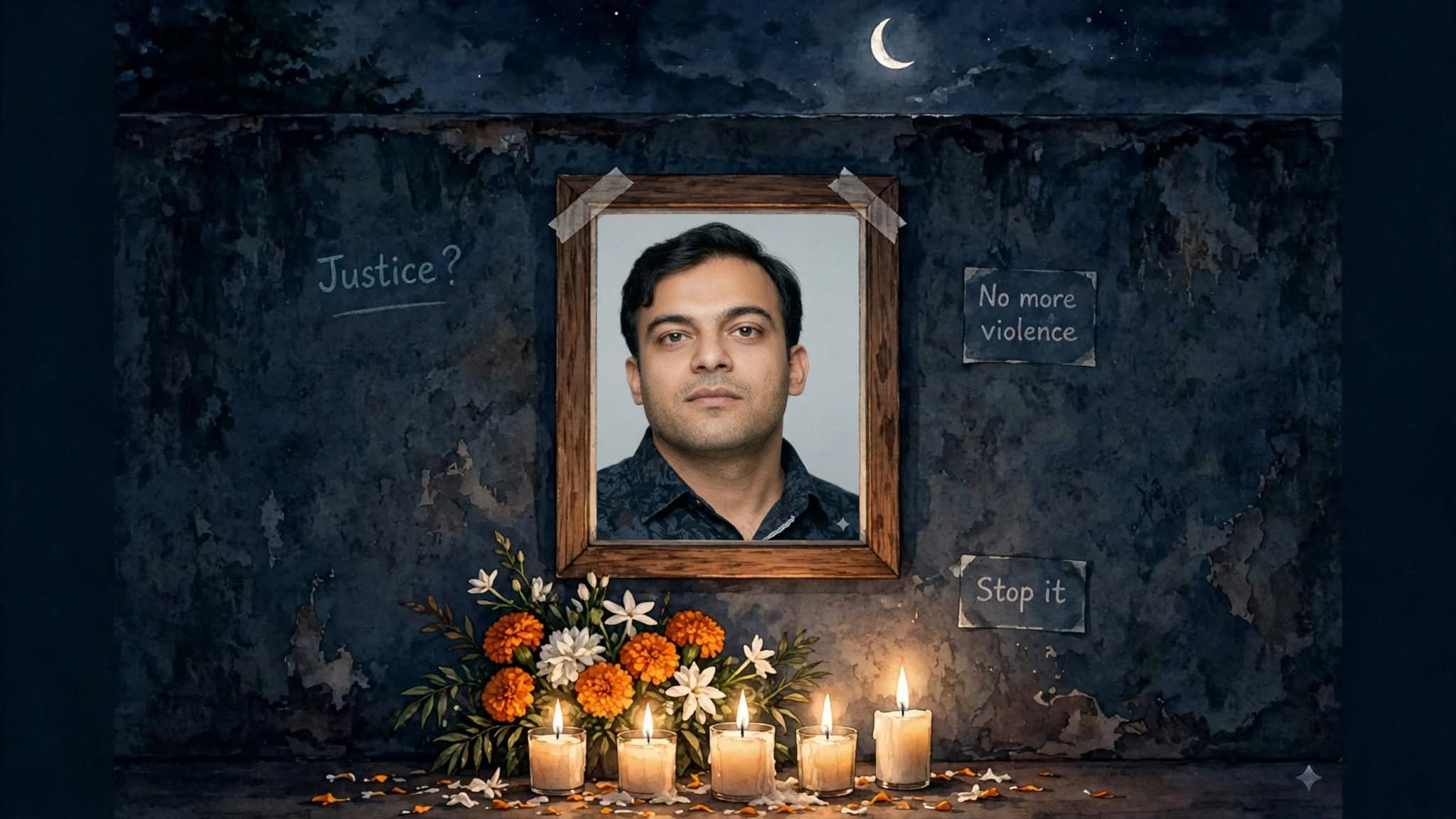
Editorial illustration based on a family album photograph.
October 25, 2004. I was a novice reporter, just starting journalism at Ajker Paribartan, a regional daily based on Barishal’s Parara Road. It was the holy month of Ramadan. Work in the newsroom typically started later during the fasting month, so even as the clock ticked past 9:00 PM, the newsroom was still buzzing.
Then came the sudden, chilling news: Mahbubul Ahmed Mehedi, the general secretary of the city Jubo Dal and a popular ward commissioner of the city corporation, had been killed in a shootout with the Rapid Action Battalion (RAB).
The initial report claimed that RAB had moved to apprehend him; he opened fire, and the elite force retaliated. At the time, the now-familiar narrative of state-sponsored extrajudicial killing had not yet become a routine bullet point in newsroom reporting.
More than two decades have elapsed since that grim evening. With the enactment of the Special Response Battalion (SRB) Act, 2026, on September 10, Bangladesh overhauled its national security framework, formally disbanding the controversial paramilitary unit RAB to pave the way for the newly established SRB.
The paramilitary force that snuffed out Mehedi’s life has itself been consigned to history. Yet, despite the tectonic shifts in national politics and institutional restructuring, Mehedi’s family remains suspended in a cruel vacuum of unachieved justice.
Akter Faruk Shahin, who served as The Daily Star’s Barishal correspondent in 2004 and later investigated the case for Jugantar in 2022, recounted the grim reality to One-man Newsroom: “This was the very first ‘crossfire’ by RAB in Barishal. People surrounded them; they were trapped at the scene for a long time.”
“The family initiated a legal battle seeking justice for his murder, but it went nowhere,” Shahin said.
The Unfading Portrait
As the calendar turned to mark Mehedi’s 22nd death anniversary, the wounds bled afresh. Asma Parvin Ratna, Mehedi’s sister-in-law, took to social media to pen a heartrending tribute: “My brother-in-law Mehedi, the most beautiful human being I have ever seen.”
“Such an aristocratic, serene face! How mesmerizing and fathomless his two eyes were! His heart was as pure and simple as a child’s. How handsome he looked in a panjabi! Ever since childhood, he loved to stay neat and organized…”
“When I got married, Mehedi was barely twelve or thirteen. I watched him grow up right before my eyes, from childhood to adolescence, and then toward the threshold of youth. We share so many memories wrapped around him. Everyone in the family adored him,” Asma added.
“When my mother-in-law passed away, Mehedi was only a year and a half old. Before he could even feel what a mother’s love or a mother’s touch meant, our beloved brother was motherless. Perhaps that is why he reached out to his mother before anyone else,” she continued.
“Today marks his 22nd death anniversary. October 25 is an infinite and unspeakable day of sorrow for us. The ache in our hearts for Mehedi is a wound that bleeds without end.”
Beyond her public post, Ratna unveiled the harrowing, claustrophobic details of that night in an exclusive talk with One-man Newsroom. According to her, Mehedi’s two sisters were confined inside an adjacent room within the household compound while the raid unfolded.
“My sister-in-law Asma heard Mehedi calling out for her loudly by name. He used to call her ‘Nani’ (grandmother). He kept crying out, ‘Nani, save me!’ They tortured him mercilessly right up until his death. He was taking a bath when they (RAB) came. He was fasting. It all happened right after Iftar,” Asma said.
Recalling the poignant final moments before the tragedy, she added, “He adored my little daughter, Namira. The day before he was killed, we spoke for a long time. He kept saying how much he longed to see Namira.” With a voice heavy with grief and unyielding resolve, she noted, “I have so much to write about Mehedi. Perhaps I will. I must. People need to know. It is time to strip the masks off many faces.”
The Daily Star Archives
The chilling contemporary dispatch published in The Daily Star on October 26, 2004, captured the state narrative in stark contrast to the family’s anguish: “A city Jubo Dal leader and ward commissioner was killed in a shootout last night with Rapid Action Battalion (RAB), which later seized huge arms and ammunition from his house.”
“Mahbubul Ahmed Mehedi, general secretary of city Jubo Dal, youth front of ruling BNP, and commissioner of ward no. 14 of Barishal City Corporation, died in the shootout at about 8:30 PM at his Bangla Bazar house, RAB sources said.”
Detailing the official version of the raid, the report continued: “RAB sources said when a team of RAB-6 raided the house of Mehedi, he opened fire at them. The RAB men also fired shots in retaliation, leaving Mehedi killed on the spot.”
“Two RAB members were also injured in the shootout, they claimed. The RAB men then seized one submachine gun, one shotgun, one pipe gun, one revolver and huge amounts of ammunition from Mehedi’s house.”
The report noted that as news of his death rippled through the city, hundreds of furious party loyalists and locals converged on the scene, triggering clashes that forced security forces to fire nearly 30 blank rounds to disperse the enraged crowd.
Shadows of Power
Decades later, on Mehedi’s 18th death anniversary in 2022, political undercurrents surfaced violently when his eldest brother, prominent businessman Shafiqul Alam Gulzar, broke his silence with a bombshell social media disclosure, later detailed in the daily Jugantar.
“Today marks the 18th death anniversary of my brother. Why did my brother have to give his life? Dear people of Barishal, I want to let you know today who is behind this murder,” Gulzar wrote, pointing a direct finger at the entrenched political elites of the era.
“This killing was orchestrated under the indirect patronage of those who were the political godfathers of Barishal at the time.”
Gulzar explicitly implicated high-ranking figures, including then-Member of Parliament and central leader of BNP, Mazibur Rahman Sarwar, Syed Moazzem Hossain Alal, and local party functionaries, alleging that Mehedi’s meteoric rise and mass popularity triggered lethal jealousy.
He claimed that the family initially filed a murder case, but it was mysteriously subverted and expunged without their knowledge.
The Defense of the Accused
Confronted with these grave allegations, the accused leaders offered their respective rebuttals to Jugantar. Denying any complicity, Mazibur Rahman Sarwar stated, “These are nothing but fabrications. The BNP was in power back then. Mehedi was our boy. Following his death in crossfire, we staged protests and demonstrations.”
“Even back then, one or two members of Gulzar’s family tried to float such claims, but Gulzar himself refuted them. Why he is spinning these contradictory tales now is best known to him,” he added.
Meanwhile, Syed Moazzem Hossain Alal remarked, “Mehedi’s killing was truly a mysterious incident. A judicial inquiry should have been conducted to determine the motives and the culprits behind it. His family should have been vocal about this from the outset. I never engaged in politics in Barishal city; I operated in the rural zones. Why Gulzar brings up my name eighteen years later is beyond me.”
“However, I believe in everyone’s freedom of expression and have no further comments to make,” he said.
An Unfinished Elegy
RAB, born as an instrument of extrajudicial might, has been dissolved into the annals of history under the SRB framework. Yet, 22 years later, the dossier on Mehedi remains an open wound.
Asma Parvin Ratna’s agonizing lament and her family’s persistent pursuit of truth stand as a haunting testimony to a timeless reality: while governments rise, fall, and reform, the collateral damage of impunity leaves behind scars that time can never quite erase.
Leave a Reply