
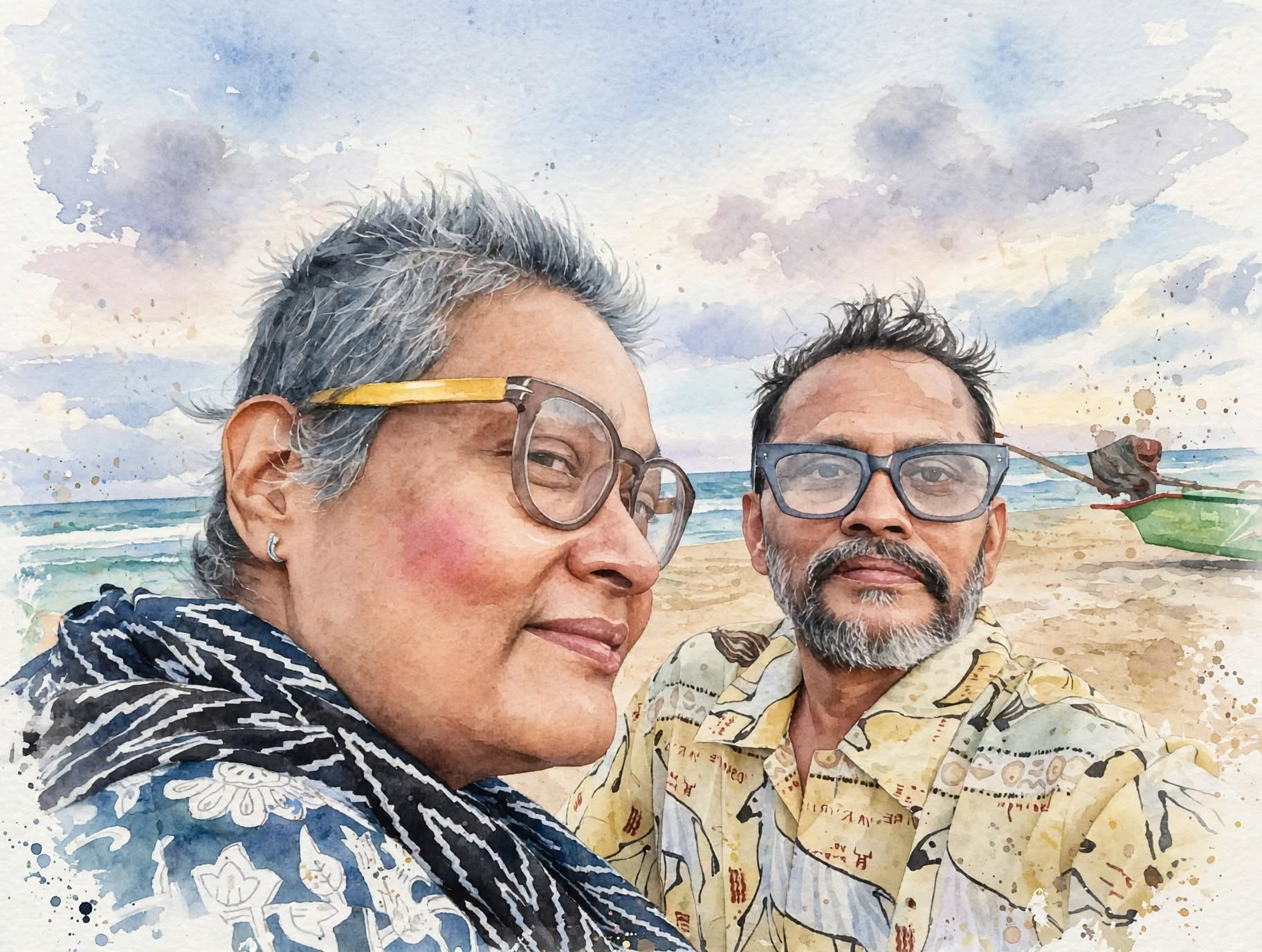
AI reconstruction based on a photograph taken by Nurul Alam Atique.
Matia Banu Shuku, a National Film Award-winning producer, playwright and filmmaker, was rushed to the intensive care unit of Continental Hospital (formerly United Hospital) in Dhaka at 7 AM on Saturday (November 21). She had been in a cabin until then. A sharp drop in her oxygen saturation forced the transfer.
The cancer has spread, and she now requires 15 to 20 litres of oxygen. Permission has been given for a central venous line, but no final decision has been made on life support.
Tazul Haque, a family friend of Shuku and her husband Nurul Alam Atique, is at the hospital. He told One-man Newsroom at around 3:15 PM that her condition is steadily deteriorating. Her kidneys are not functioning properly, and preparations for dialysis are underway.
Shuku is the eldest daughter of Abdul Matin, a leading figure of Bangladesh’s Language Movement. She is one of the essential voices in the country’s serious, independent-minded cinema and theatre. For nearly two decades she has worked quietly, away from the glare of publicity.
In an interview about five years ago, she said, “My work and my life are not separate things. They are the same. One has dissolved into the other.” In another remark, she said, “I want my work to touch people’s minds and their sensibilities.”
With her husband and creative partner Atique, a filmmaker who has won national awards several times, she runs the production house Pandulipi Karkhana (meaning ‘the Manuscript Workshop’). Together they have built a new grammar for alternative Bangladeshi cinema, in both storytelling and form.
Shuku backed Atique’s experimental work without wavering, and Atique’s creative energy fed hers in turn. Through this illness, he has not left her side. Their film Manusher Bagan (in English, People of the Garden) won an international award in New Delhi in May 2026. They were in the middle of the fight against her illness even then.
The daughter of a legend
For readers outside Bangladesh, some history explains why Shuku’s lineage carries such weight. On March 24, 1948, Muhammad Ali Jinnah, Governor-General of the newly created Pakistan, stood in Curzon Hall at the University of Dhaka and declared Urdu the sole state language.
Most people in East Pakistan spoke Bengali. In the silence that followed, Abdul Matin was the first to protest. Standing on a chair among the students, he shouted, “No, no.” The university expelled him for two years. That refusal laid part of the groundwork for the movement that peaked in 1952 and eventually led to Bangladesh’s independence.
Shuku has always spoken of her father with deep respect. She has described one line of his as the guiding principle of her life: “You are the child of a language soldier. Your responsibility is greater.” That conviction shaped her view of art, not as mere entertainment but as an instrument of social change. She has said her father told stories in a vivid, almost cinematic way, and that this is where her own habit of imagining scenes and writing stories began.
A fine arts graduate, Shuku later discovered that her father had drawn beautifully too. She was delighted to find one of his sketchbooks. After graduating, she illustrated textbooks for the National Curriculum and Textbook Board.
When she moved into theatre and film, she never wanted to be placed in a separate ‘woman filmmaker’ category. Working through the same obstacles as male directors seemed natural to her. She has said she does not consider herself a feminist in the theoretical sense, but that she feels most at ease with women’s stories, “Writing about women comes easily to me. It feels natural.”
A personal note
In 2015 I joined Pandulipi Karkhana to help develop the screenplay of Lal Moroger Jhuti (literally, ‘Call of the Red Rooster’), the film that earned Shuku her National Film Award. Even then, I heard her say often that cinema has its own international language, one that needs no particular spoken tongue. If the imagery and staging are strong enough, she would say, viewers anywhere can follow and connect without subtitles.
I later worked with her as a cinematographer on television drama and saw that visual intelligence first-hand. With very modest resources, she can fill the frame with a vast canvas. Her fine arts training perhaps explains her sensitive, meaningful use of colour. She also mixes easily with people, which is why her stories draw marginalised and varied lives into a single thread, laced with a subtle humour.
A hard month
On September 5, her birthday, I wrote a piece about her. She was in Chennai, India, receiving cancer treatment, far from home. A day or two after her birthday, she returned to Bangladesh. Her struggle has continued in Dhaka since then, and today it has brought her to intensive care.
Cancer treatment is expensive and long. Without financial security or any form of state insurance, it is hard to walk. Friends and loved ones have stood by her throughout. Her ordeal is a reminder that artists who give their lives to their craft and their society deserve a lasting system of state support in illness and old age. Such support should be seen not as charity but as a rightful honour.
Shuku taught us what uncompromising honesty toward one’s art looks like, and why it matters more than publicity. The responsibility she inherited as a language soldier’s daughter shines in every frame she has made. Today, Atique and those closest to her are in the hospital corridors. Those of us who carry her work and her kindness, from a distance, are with her too, in prayer.
Leave a Reply