
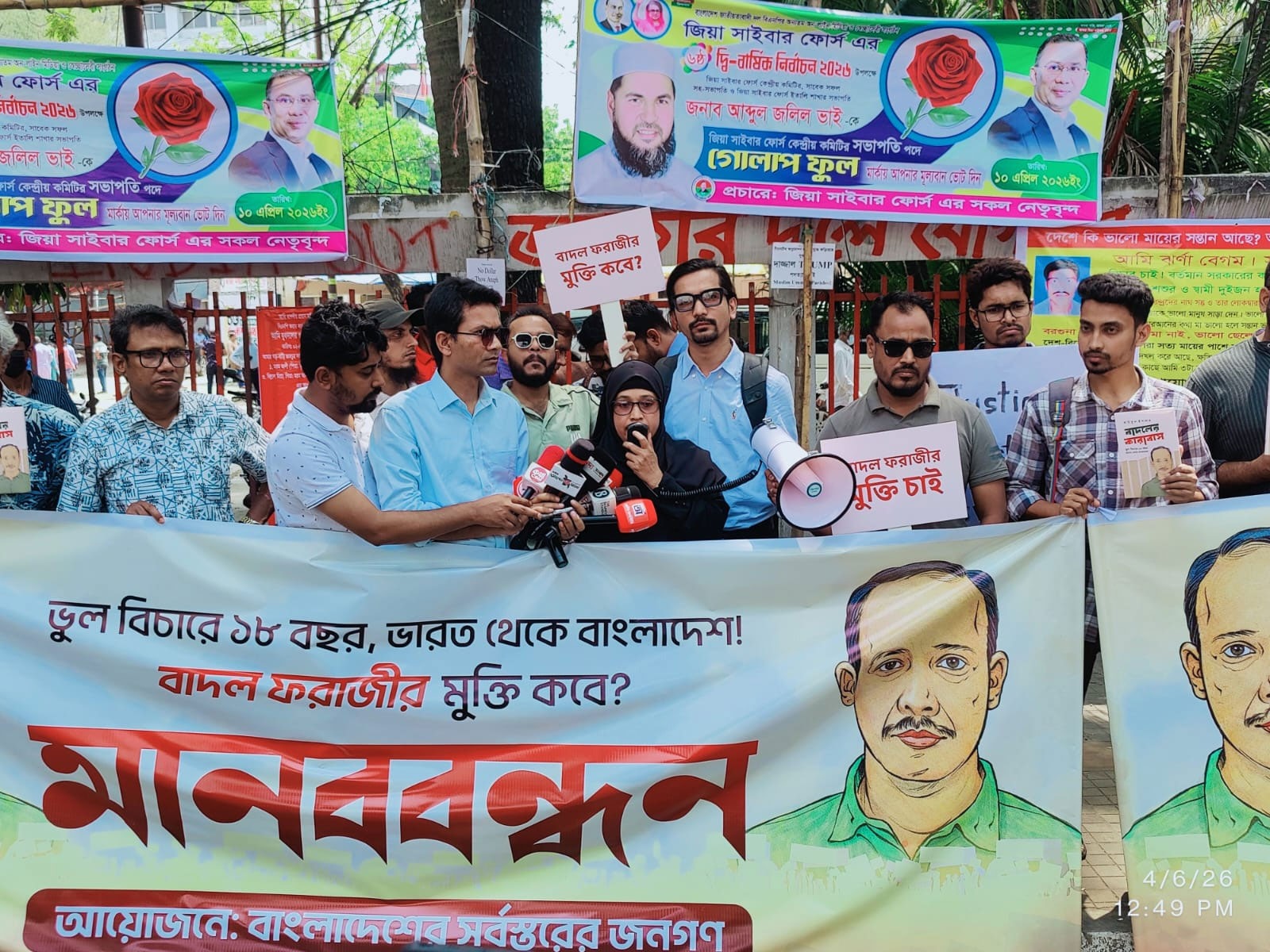
Aklima Akter, sister of imprisoned Bangladeshi man Badal Farazi, speaks during a protest demanding his release at the National Press Club in Dhaka, Bangladesh, on April 6, 2026.
📷 Press Release
A coalition of writers, journalists, and human rights activists has launched a campaign demanding the immediate release of Badal Farazi, a Bangladeshi man who has spent 18 years in prison after being mistakenly identified in a murder case.
At a protest held at the National Press Club in Dhaka on Monday (April 6), organizers issued a seven-day ultimatum to the government. They warned that activists would stage a sit-in outside the Indian High Commission if Farazi is not released.
Campaigners say his legal sentence expired four years ago. Farazi’s elder sister, Aklima Akter, broke down in tears while speaking about the family’s long wait for justice.
“My father died waiting for his son to return,” she said. “My mother is now on her deathbed. She only wants to see her innocent son once before she dies.”
“It has been 18 years. How much longer must we wait?” Aklima asked. Organizers say the campaign originated from an unlikely encounter inside a prison cell.
Journalist R.K. Jan, who oversees media coordination for the campaign, informed One-man Newsroom that the quest for Farazi’s freedom began when writer Rahitul Islam met the prisoner while himself briefly behind bars.
Rahitul later wrote a book about the case titled Badaler Karabas (Badal’s Imprisonment). “Badal allowed Rahitul to tell his story,” Jan said.
“Driven by a sense of justice, Rahitul committed to launching a formal advocacy campaign for Farazi’s release immediately following the publication of his book.”
“Today, Rahitul Islam, Pavel Babu, co-founder of Prochesta Foundation, and Aklima Akter have come together to fulfil that promise,” he added.
Rahitul Islam informed the gathering that Farazi’s continued detention raises serious legal and humanitarian concerns.
According to his account, Farazi has remained in custody despite having completed his required sentence under Indian law as of July 20, 2022.
“Yet he remains in prison due to bureaucratic delays,” Islam said. “This is a clear violation of human rights.”
Journalist R.K. Jan said the case has remained unresolved despite two changes of government in Bangladesh. “This is no longer only a legal issue,” he said. “It reflects a lack of political urgency.”
A Case of Mistaken Identity
Farazi’s ordeal began on July 13, 2008. A mechanic from Mongla in southwestern Bangladesh, he crossed the Benapole–Haridaspur border into India, hoping to visit the Taj Mahal.
Instead, India’s Border Security Force (BSF) detained him, who believed he was “Badal Singh,” a domestic worker accused of murdering an elderly woman in Delhi’s Amar Colony on May 6, 2008.
Limited by his native Bengali, Farazi struggled to convey his situation to the Hindi-speaking officers during his initial detention. He was unable to explain that he had only recently entered India and was not present in the country when the crime occurred.
Despite this, he was convicted of murder under Section 302 of the Indian Penal Code and sentenced to life imprisonment. Farazi was at Delhi’s Tihar Jail, where he spent years alongside some of India’s most high-profile inmates.
Education Behind Bars
While imprisoned in Tihar Jail, Farazi continued his education. He completed his secondary and higher secondary examinations and later earned bachelor’s and master’s degrees.
Over the years, he also learned English and Hindi. Fellow inmates say he later began teaching other prisoners and completed eight diploma courses while in custody.
His case began attracting international attention after Indian activist Rahul Kapoor launched the “Justice for Badal” campaign.
Writers and human rights advocates, including author Arundhati Roy and PEN International, raised concerns about the case and urged authorities to review it.
After spending about a decade in Tihar Jail, Farazi was repatriated to Bangladesh in 2018 under a bilateral prisoner-transfer agreement between the two countries.
However, instead of being released, he was transferred to Kashimpur Central Jail in Gazipur to complete the remainder of the sentence imposed by the Indian court.
Under the provisions of the treaty, prisoners transferred between the two countries must serve the remaining term of their sentence in their home country.
Legal Deadlock
The case has since become entangled in legal and diplomatic procedures. Several legal efforts to secure release have faced obstacles.
In 2018, the High Court rejected a writ petition filed by Advocate Humayun Kabir Pallab, determining that Farazi’s release was a matter of state policy rather than a purely judicial mandate.
In 2019, the legal aid organisation Ain o Salish Kendra (ASK) filed another petition arguing that Farazi’s continued detention violated his fundamental rights.
In 2022, Bangladesh’s Ministry of Home Affairs sought a “No Objection Certificate” from India regarding his release. Activists say the process has remained stalled.
On December 29, 2024, lawyers also served a legal notice demanding Farazi’s immediate release and $10 million in compensation from the Indian government as an 18-year miscarriage of justice.
A Case Widely Reported
Farazi’s ordeal has been a recurring headline in both Bangladeshi and Indian press, sparking a cross-border discourse on judicial errors and human rights.
The Times of India published a report titled “Bangladeshi man not in India at the time of crime to be sent back home,” citing evidence that he entered India two months after the murder.
The Indian Express and The Print have also covered the “Justice for Badal” campaign, highlighting discrepancies between the identities of “Badal Singh,” the suspect in the murder case, and Badal Farazi.
In Bangladesh, Prothom Alo (English) reported on the legal stalemate under the headline “Prison sentence over, but no freedom for Badal Farazi.”
Other outlets, including The Daily Sun and UNB, have reported on the diplomatic complications surrounding the 2018 prisoner-transfer agreement.
For activists, the case has come to symbolize what they describe as a rare but devastating example of cross-border judicial failure, one that has kept an innocent man behind bars for nearly two decades.
Leave a Reply